‘There's no one-size-fits-all approach’: Investigating the long-term impacts of concussions in adolescent athletes
School of Medicine researcher Jessie Oldham, Ph.D., was awarded her first individual federal research grant to further research youth concussion recovery.
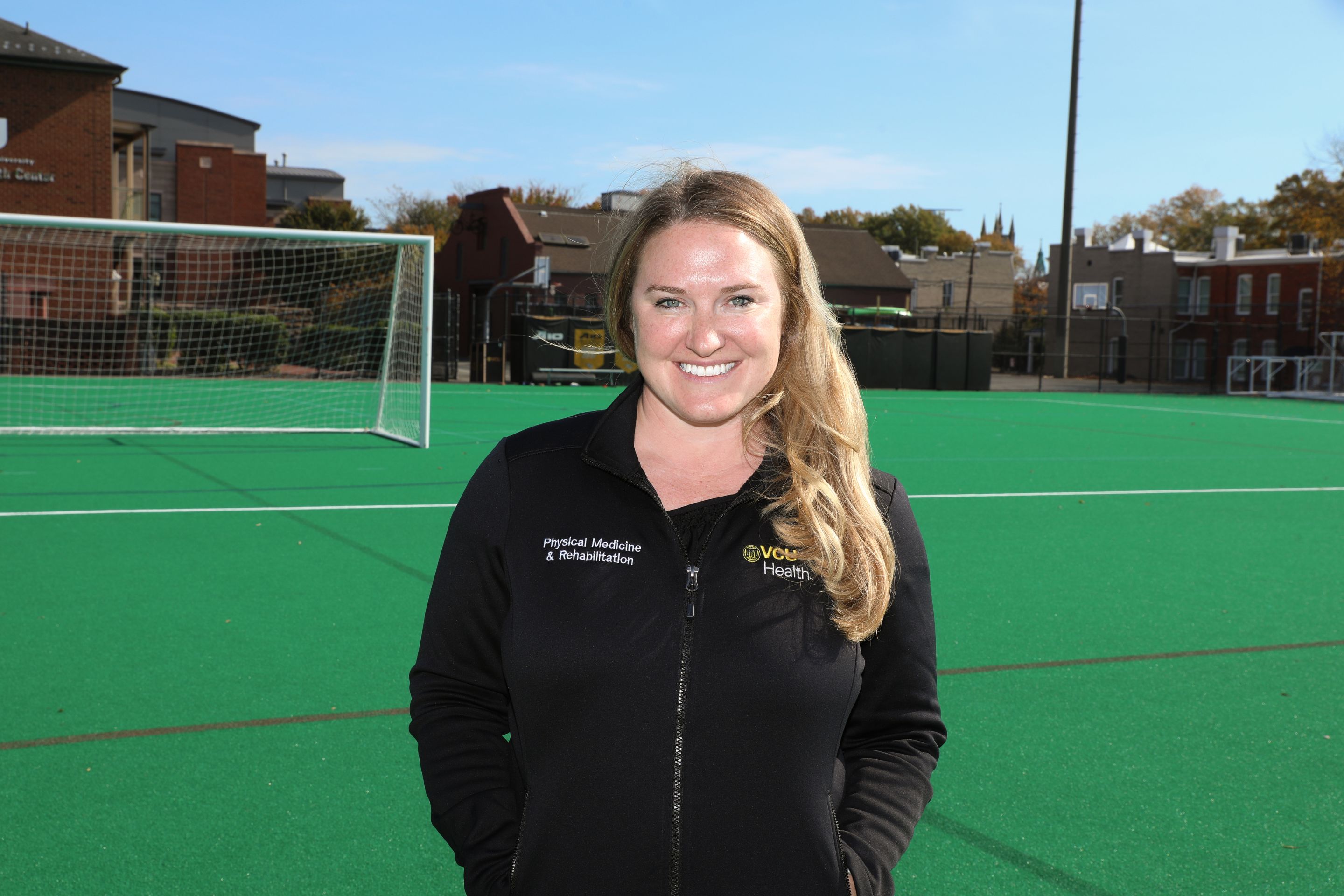
Jessie Oldham, Ph.D., is researching the effects of concussions on adolescent athletes in an effort to make sports safer and maintain youth athletic participation (Photo by Arda Athman, School of Medicine)
As a former gymnast and cheerleader, Jessie Oldham, Ph.D., can attest to the confidence, teamwork and sense of accomplishment youth athletes gain through their sports. Unfortunately, she also has experience being sidelined from the activities she loved after sustaining one of the most common injuries in youth athletics — a concussion.
Now an assistant professor in the Department of Physical Medicine and Rehabilitation, Oldham has dedicated her academic research career to understanding the long-term effects of concussions on adolescent athletes, with the goal of improving safety in youth sports.
In August, that dedication was recognized by the National Institutes of Health, which awarded Oldham her first individual research grant to further investigate the subject.
“Over the last decade, concussion awareness has increased significantly because of new information coming from research. It has led to a lot of great safety changes in youth sports,” Oldham said. “Knowing even more about the long-term impacts and being able to educate coaches, physicians and parents will help us prevent future injuries and keep kids in athletics.”
Investigating the invisible
In recent years, researchers have found evidence that, even after symptoms subside, athletes with a past concussion are more at risk of sustaining future musculoskeletal injuries like lower-body sprains and muscle tears. Oldham wants to understand why these athletes are at a higher risk of injury.
Last year, she and her team began observing groups of adolescent athletes, some who were recently concussed, and others who were previously concussed but medically cleared to return to play. In both groups, they found novel evidence that the acoustic startle reflex, which is an involuntary reaction to a sudden loud noise, was suppressed. That suppression was still present in study subjects who later sustained a musculoskeletal injury — the potential consequence of which, Oldham noted, could be serious.
“Some of these subsequent injuries, like a bad ACL tear, can be career-ending,” Oldham said. “Being able to identify who is more at risk for these injuries and developing a protocol for players at risk will help keep kids safe and in their sport.”
Finding evidence of a prolonged suppression of the startle reflex necessitates further investigation into how long that suppression lasts, Oldham said. The NIH agreed, and in August, awarded Oldham funding via an R01 grant for a larger study of adolescent athletes over five years. In addition to building upon previous findings, the study will also investigate the startle potentiation, or the heightened startle reflex in response to expected and unexpected threats, in healthy and previously concussed adolescent athletes.
“In an athletic scenario, an expected threat may be a soccer ball coming down and an athlete preparing to take a header, while an unexpected threat is a football player being tackled from the back,” Oldham said. “The player’s startle reflex in those situations could mean the difference between no injury at all and a major surgery.”
This is the first R01 grant for both Oldham and the department, an accomplishment she has been working toward since beginning graduate school more than a decade ago.
“Throughout my training, an R01 was always held up as the pinnacle of achievement," Oldham said. “It's very exciting and I just want to make the department and university proud.”
David Cifu, M.D., Herman Jacob Flax, M.D., Tenured Professor and chair of the Department of PM&R, commended Oldham for her work, which he said has been integral in expanding the scope of concussion research at VCU.
“Dr. Oldham brings deep scientific expertise and a growing renown within her specialty area of youth concussion that has enabled her to both establish a national research team and secure NIH funding,” Cifu said. “She balances her academic and leadership skills with a warm, collaborative approach that welcomes and effectively integrates research partners, subject matter experts and trainees to create a high-functioning program.”
Promoting scientific progress
Most concussion research is conducted on the college and professional levels, predominantly adult and male populations. Working with both male and female adolescents allows Oldham to explore a wider range of sports.
Since arriving at the School of Medicine in 2021, Oldham has been an affiliate faculty member at the Institute for Women’s Health, VCU’s center for interdisciplinary research into women’s health and sex differences. Here, she co-chairs the Female Athlete Research Development Group, which aims to foster interdisciplinary research and innovation into the health and well-being of women of all ages in physical activity.
Within the population of adolescent athletes, female athletes have historically been underrepresented in research, despite being more likely to sustain a concussion while playing sports. Oldham said she's observed the disparity in representation lessening, in part, because of an increasing number of women in sports medicine research.
“When I was getting my master’s in 2011, nearly all of the research I was citing was published by men and the populations in these studies were predominantly male,” Oldham said. “Having more women in the field ultimately increases the recognition of sex differences in the effects and recovery from concussions.”
Oldham said she hopes more thorough research into sex differences will encourage investigators to expand their population pools and include other groups historically underrepresented in concussion studies.
“Inclusion means more than just advancing science, but creating better outcomes for more people,” Oldham said. “There’s no one-size-fits-all approach in concussion recovery and studies need to reflect that.”
Send us your stories!
The School of Medicine communications team is always looking to highlight student success, faculty achievement, cutting-edge research and innovative initiatives around the MCV Campus. If you have an idea for a story, please submit your pitch to laura.ingles@vcuhealth.org.
As a former gymnast and cheerleader, Jessie Oldham, Ph.D., can attest to the confidence, teamwork and sense of accomplishment youth athletes gain through their sports. Unfortunately, she also has experience being sidelined from the activities she loved after sustaining one of the most common injuries in youth athletics — a concussion.
Now an assistant professor in the Department of Physical Medicine and Rehabilitation, Oldham has dedicated her academic research career to understanding the long-term effects of concussions on adolescent athletes, with the goal of improving safety in youth sports.
In August, that dedication was recognized by the National Institutes of Health, which awarded Oldham her first individual research grant to further investigate the subject.
“Over the last decade, concussion awareness has increased significantly because of new information coming from research. It has led to a lot of great safety changes in youth sports,” Oldham said. “Knowing even more about the long-term impacts and being able to educate coaches, physicians and parents will help us prevent future injuries and keep kids in athletics.”
Investigating the invisible
In recent years, researchers have found evidence that, even after symptoms subside, athletes with a past concussion are more at risk of sustaining future musculoskeletal injuries like lower-body sprains and muscle tears. Oldham wants to understand why these athletes are at a higher risk of injury.
Last year, she and her team began observing groups of adolescent athletes, some who were recently concussed, and others who were previously concussed but medically cleared to return to play. In both groups, they found novel evidence that the acoustic startle reflex, which is an involuntary reaction to a sudden loud noise, was suppressed. That suppression was still present in study subjects who later sustained a musculoskeletal injury — the potential consequence of which, Oldham noted, could be serious.
“Some of these subsequent injuries, like a bad ACL tear, can be career-ending,” Oldham said. “Being able to identify who is more at risk for these injuries and developing a protocol for players at risk will help keep kids safe and in their sport.”
Finding evidence of a prolonged suppression of the startle reflex necessitates further investigation into how long that suppression lasts, Oldham said. The NIH agreed, and in August, awarded Oldham funding via an R01 grant for a larger study of adolescent athletes over five years. In addition to building upon previous findings, the study will also investigate the startle potentiation, or the heightened startle reflex in response to expected and unexpected threats, in healthy and previously concussed adolescent athletes.
“In an athletic scenario, an expected threat may be a soccer ball coming down and an athlete preparing to take a header, while an unexpected threat is a football player being tackled from the back,” Oldham said. “The player’s startle reflex in those situations could mean the difference between no injury at all and a major surgery.”
This is the first R01 grant for both Oldham and the department, an accomplishment she has been working toward since beginning graduate school more than a decade ago.
“Throughout my training, an R01 was always held up as the pinnacle of achievement," Oldham said. “It's very exciting and I just want to make the department and university proud.”
David Cifu, M.D., Herman Jacob Flax, M.D., Tenured Professor and chair of the Department of PM&R, commended Oldham for her work, which he said has been integral in expanding the scope of concussion research at VCU.
“Dr. Oldham brings deep scientific expertise and a growing renown within her specialty area of youth concussion that has enabled her to both establish a national research team and secure NIH funding,” Cifu said. “She balances her academic and leadership skills with a warm, collaborative approach that welcomes and effectively integrates research partners, subject matter experts and trainees to create a high-functioning program.”
Promoting scientific progress
Most concussion research is conducted on the college and professional levels, predominantly adult and male populations. Working with both male and female adolescents allows Oldham to explore a wider range of sports.
Since arriving at the School of Medicine in 2021, Oldham has been an affiliate faculty member at the Institute for Women’s Health, VCU’s center for interdisciplinary research into women’s health and sex differences. Here, she co-chairs the Female Athlete Research Development Group, which aims to foster interdisciplinary research and innovation into the health and well-being of women of all ages in physical activity.
Within the population of adolescent athletes, female athletes have historically been underrepresented in research, despite being more likely to sustain a concussion while playing sports. Oldham said she's observed the disparity in representation lessening, in part, because of an increasing number of women in sports medicine research.
“When I was getting my master’s in 2011, nearly all of the research I was citing was published by men and the populations in these studies were predominantly male,” Oldham said. “Having more women in the field ultimately increases the recognition of sex differences in the effects and recovery from concussions.”
Oldham said she hopes more thorough research into sex differences will encourage investigators to expand their population pools and include other groups historically underrepresented in concussion studies.
“Inclusion means more than just advancing science, but creating better outcomes for more people,” Oldham said. “There’s no one-size-fits-all approach in concussion recovery and studies need to reflect that.”
Send us your stories!
The School of Medicine communications team is always looking to highlight student success, faculty achievement, cutting-edge research and innovative initiatives around the MCV Campus. If you have an idea for a story, please submit your pitch to laura.ingles@vcuhealth.org.
Interested in concussion research?
Medical students and graduate students who are interested in participating in ongoing studies related to concussions in youth athletes are welcome to email Jessie Oldham, Ph.D. at jessie.oldham@vcuhealth.org.
Tags: