A window into pain
As students explore "Frida: Beyond the Myth" at the Virginia Museum of Fine Arts, they dive deeper into Kahlo's chronic pain via a writing assignment and body mapping exercise.
Photography by Skip Rowland
“They thought I was a surrealist, but I wasn’t. I never painted dreams. I painted my own reality.” — Frida Kahlo
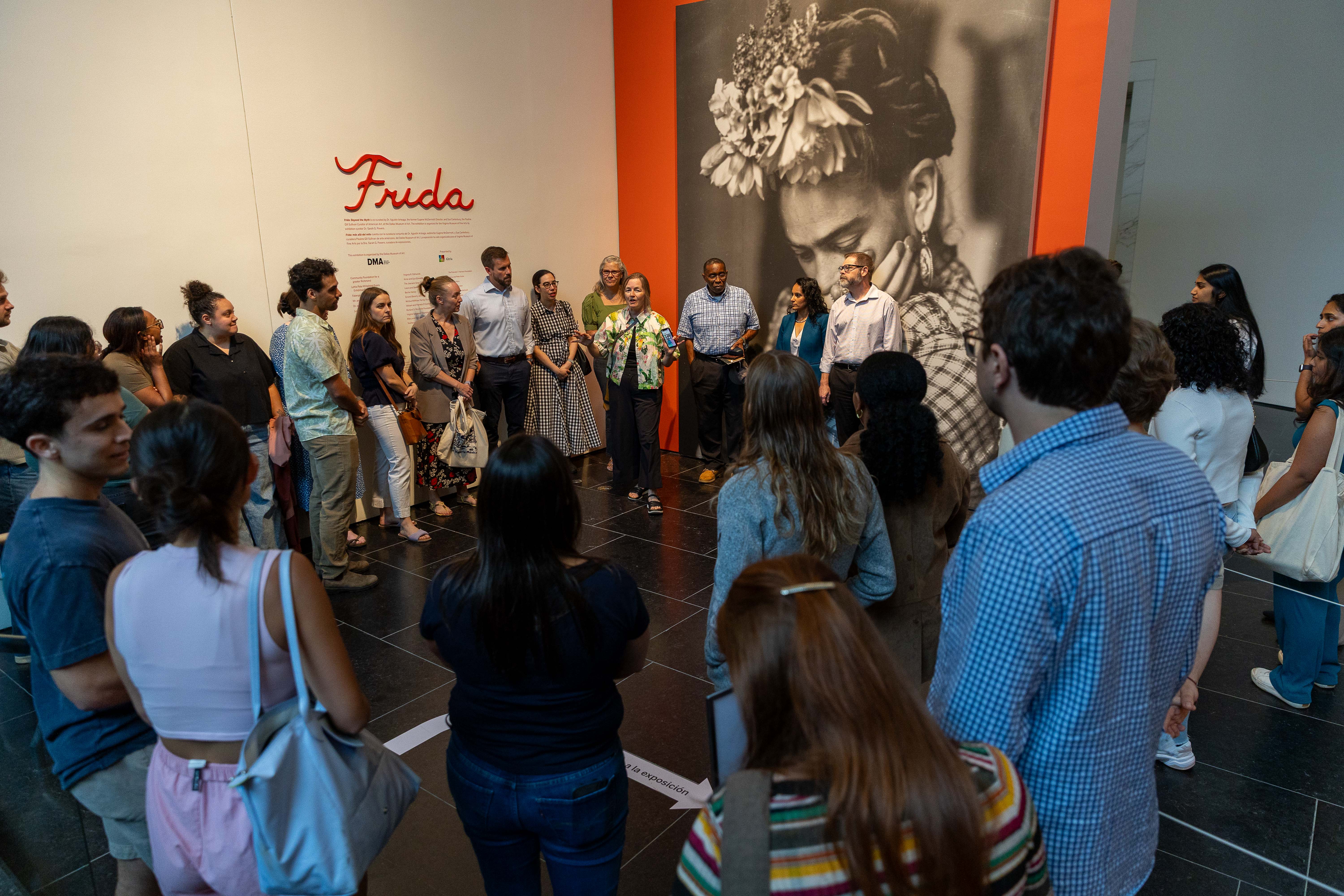
On a Friday night in August, 30 medical students gathered at the Virginia Museum of Fine Arts for a tour of the visiting exhibition, “Frida: Beyond the Myth,” featuring the Mexican artist Frida Kahlo.
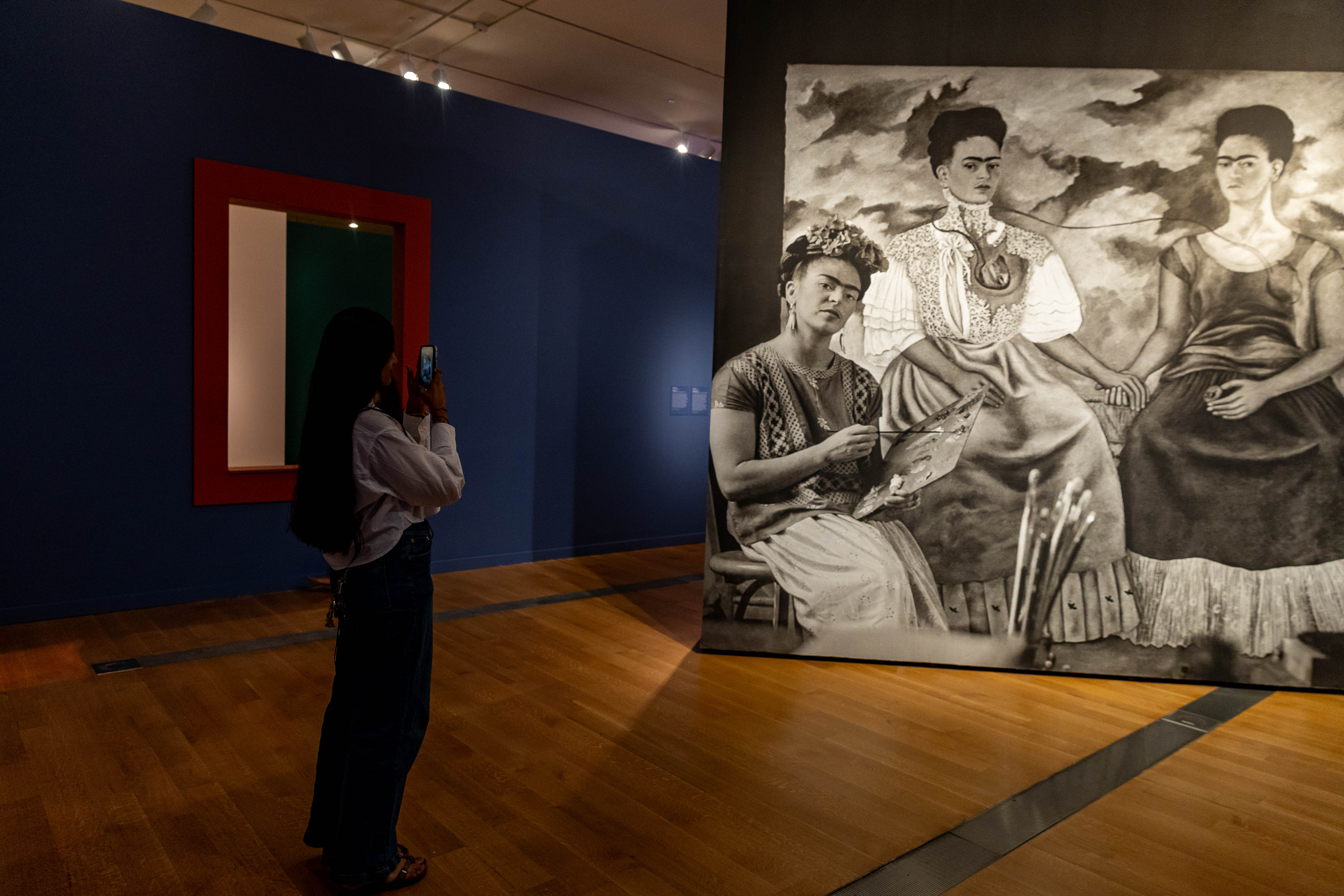
Following a bus accident as a teenager, Kahlo dealt with lifelong chronic pain — a theme that was often symbolized in her expressive paintings. As the students paced the rooms of the exhibition, studying photos of the artist and her self-portraits, they searched for hints of Kahlo’s experience. Could her stoic expression be a mask for her inner pain? Is the style of her hair an insight into her deteriorating health? Do paintings of ripe, open fruits suggest her desire for children?
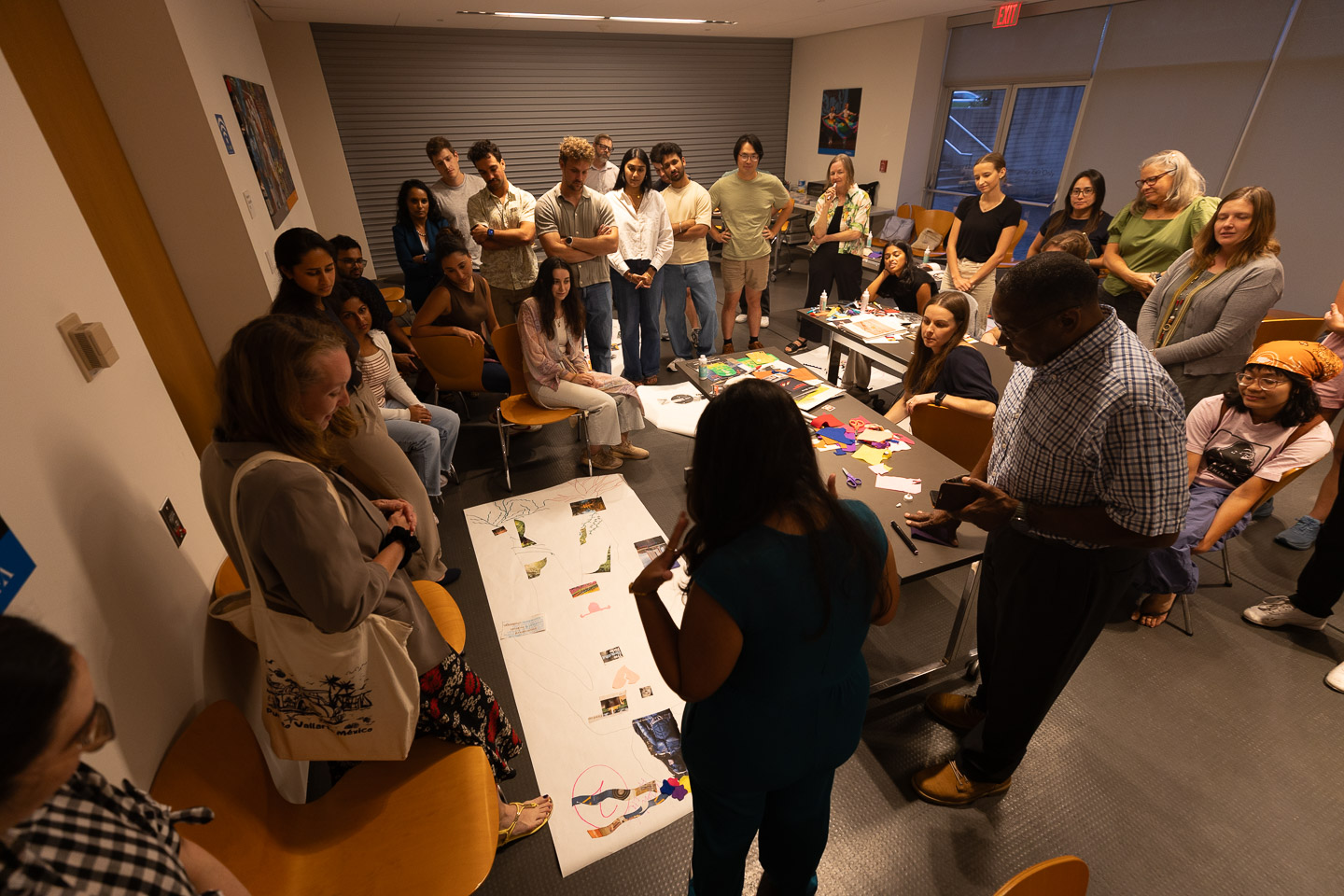
Students worked together on a body mapping exercise after their museum tour of “Frida: Beyond the Myth” as part of the School of Medicine’s Patient, Physician and Society curriculum to nurture caring and compassionate physicians.
Later that evening, in a conference room upstairs, the students tried to map Kahlo’s pain onto a drawing of a human body with sketches, collages and multimedia materials. While they worked, the questions continued. Could an image of iron latticework represent the web of pain in her body? Could a spine made of felt extending down the legs communicate the nature of radiating pain?
While these questions were part of a dialogue about a single artist’s experience with lifelong pain, they also represented the kinds of conversations that regularly take place in the VCU School of Medicine’s Patient, Physician and Society curriculum — a four-year program designed to nurture caring and compassionate physicians.
“I like to tell people the PPS course is everything that’s not in a science textbook,” says Melissa K. Bradner, M.D., who completed her residency training on the MCV Campus in 1999 and is now a professor in the Department of Family Medicine and Population Health and M3/M4 course director for PPS. “It’s the doctor-patient relationship, shared decision-making, death and dying, palliative care. It’s a chance to think about pain in a more complex way.”
"My painting contains in it the message of pain."
Kahlo’s life was marked by trauma and pain — both physical and emotional.
Even before the near-fatal bus accident, Kahlo had contracted polio at age 6. Then at 18, her grave injuries caused her to spend more than a year in bed recovering from multiple fractures of her back, collarbone and ribs, as well as a shattered pelvis. Kahlo spent the rest of her life in constant pain and underwent dozens of surgeries before dying of related complications at age 47.
She also struggled with emotional scars — from the accident, her tumultuous marriage to fellow artist Diego Rivera, and multiple pregnancy losses.
In some of the works on display at the VMFA, her pain is clearly visible, such as a sketch showing her bleeding on the ground in front of a bus. In others, her pain is captured in the symbolism of animals and plants, iron nails and arrows.
The exhibition also featured photos and portraits of Kahlo by friends, family and fellow artists. In many of the images, Kahlo presented her renowned emotionless expression, her body perfectly upright.
A few, however, showed the lengths she went to find comfort and hinted at the pain behind that stoic façade. In one, taken in her final years, Kahlo is shown painting from her bed, her body and easel propped up by pillows. Rivera looks on from her side. Unlike many of the portraits in the gallery, Kahlo shows a faint smile.
The collection offered a window into how one person subtly expressed and masked their pain — a lesson Bradner hopes the future doctors in her class might take into interactions with patients.
Bradner first learned of Kahlo’s bus accident when she visited Casa Azul, the artist’s house in Mexico City. When Bradner heard the exhibition would be coming to the VMFA, she requested funding from the medical school’s Helen J. Kim, M.D., and John Hayashi Medical Student Wellness Education Fund to cover the cost of the students’ admission to the special exhibit.
Bradner also assembled an interdisciplinary team of faculty to join the museum tour: a chronic pain clinician, a physical therapist and a pain psychologist, along with faculty from religion, anthropology and arts education.
“Each discipline in academics has their own way of approaching things,” Bradner says. “There’s so much opportunity to learn from one another, especially about an artist like Frida Kahlo, who had so much going on politically and historically and within her own life.
“She’s a famous person, but every single patient we see comes to us with a long history. We need to understand them in that context.”
“I paint self-portraits because I am so often alone, because I am the person I know best.”
The exercise at the VMFA consisted of two parts, beginning with a free-ranging exploration of the exhibition. To give a focus to their time, Bradner challenged students to complete one of two writing assignments: a brief story in the voice of Kahlo as if she were their patient, or a physician’s documentation of the pain points they might have noticed during a physical exam of her body.
Taylor Crouch, Ph.D., a pain psychologist and assistant professor in the Department of Psychiatry who helped lead the exercise, wanted to encourage students to think about how trauma, mood and biological factors all interact to shape a patient’s degree of suffering.
“As an artist, Kahlo vulnerably shared her experience,” Crouch says. “I hope this deep look into her experience will remind them to consider all of the ways that pain can impact someone behind the scenes and outside of the clinical space. That it will lead them to explore that with their patients.”
Neha Shah from the Class of 2027
The exhibit led Neha Shah, from the Class of 2027, to reflect on her experience working in a pain management clinic where her attending physician often emphasized two components of pain: the physical and the psychosocial. Kahlo’s bold expressions and strong posture also served as a reminder to look beyond a patient’s outward presentation.
“Just because Kahlo looks comfortable doesn’t mean that she’s not experiencing pain,” Shah says. “A lot of strong individuals aren’t taken seriously. As physicians, we need to acknowledge how people feel pain and try to elicit what their pain feels like.”
After an hour in the exhibition, the class gathered in a nearby conference room where they were split into six groups and paired with faculty members from across VCU. The groups worked together on a body mapping exercise. Each was given an outline of the human body, along with felt, scissors and glue, markers and magazines.
“Looking through the pictures, we were trying to find similarities to Kahlo,” says Rebecca Alemu, from the Class of 2027 and recipient of the Richmond Academy of Medicine Endowed Scholarship. “It’s like what you do when a patient comes in. You try to relate to their life.”
They filled the outline with drawings of hearts, ventricles and uteruses; collages of images; three-dimensional representations of the spine; and quotes from Kahlo. Then, they explained to the room how the images represented Kahlo’s experiences with physical and emotional pain.
Brooke Ford, also from the Class of 2027, adds that it was a reminder that every patient comes in with a whole life. “They’re not just the one issue that they’re coming to us for,” says Ford, who holds the MCV Foundation Scholarship. “With Frida, we see all of these bright colors — everyone’s life is like that in their own way.”
This story was published in the fall 2025 issue of 12th & Marshall. You can find the current and past issues online.
Visiting Richmond? Stop by the Virginia Museum of Fine Arts, located in the city’s Museum District on North Arthur Ashe Boulevard. The VMFA is one of the largest comprehensive art museums in the U.S. and the only one in the country open 365 days a year with free general admission to its permanent collection of more than 50,000 artworks.
“They thought I was a surrealist, but I wasn’t. I never painted dreams. I painted my own reality.” — Frida Kahlo
On a Friday night in August, 30 medical students gathered at the Virginia Museum of Fine Arts for a tour of the visiting exhibition, “Frida: Beyond the Myth,” featuring the Mexican artist Frida Kahlo.
Following a bus accident as a teenager, Kahlo dealt with lifelong chronic pain — a theme that was often symbolized in her expressive paintings. As the students paced the rooms of the exhibition, studying photos of the artist and her self-portraits, they searched for hints of Kahlo’s experience. Could her stoic expression be a mask for her inner pain? Is the style of her hair an insight into her deteriorating health? Do paintings of ripe, open fruits suggest her desire for children?
Students worked together on a body mapping exercise after their museum tour of “Frida: Beyond the Myth” as part of the School of Medicine’s Patient, Physician and Society curriculum to nurture caring and compassionate physicians.
Later that evening, in a conference room upstairs, the students tried to map Kahlo’s pain onto a drawing of a human body with sketches, collages and multimedia materials. While they worked, the questions continued. Could an image of iron latticework represent the web of pain in her body? Could a spine made of felt extending down the legs communicate the nature of radiating pain?
While these questions were part of a dialogue about a single artist’s experience with lifelong pain, they also represented the kinds of conversations that regularly take place in the VCU School of Medicine’s Patient, Physician and Society curriculum — a four-year program designed to nurture caring and compassionate physicians.
“I like to tell people the PPS course is everything that’s not in a science textbook,” says Melissa K. Bradner, M.D., who completed her residency training on the MCV Campus in 1999 and is now a professor in the Department of Family Medicine and Population Health and M3/M4 course director for PPS. “It’s the doctor-patient relationship, shared decision-making, death and dying, palliative care. It’s a chance to think about pain in a more complex way.”
"My painting contains in it the message of pain."
Kahlo’s life was marked by trauma and pain — both physical and emotional.
Even before the near-fatal bus accident, Kahlo had contracted polio at age 6. Then at 18, her grave injuries caused her to spend more than a year in bed recovering from multiple fractures of her back, collarbone and ribs, as well as a shattered pelvis. Kahlo spent the rest of her life in constant pain and underwent dozens of surgeries before dying of related complications at age 47.
She also struggled with emotional scars — from the accident, her tumultuous marriage to fellow artist Diego Rivera, and multiple pregnancy losses.
In some of the works on display at the VMFA, her pain is clearly visible, such as a sketch showing her bleeding on the ground in front of a bus. In others, her pain is captured in the symbolism of animals and plants, iron nails and arrows.
The exhibition also featured photos and portraits of Kahlo by friends, family and fellow artists. In many of the images, Kahlo presented her renowned emotionless expression, her body perfectly upright.
A few, however, showed the lengths she went to find comfort and hinted at the pain behind that stoic façade. In one, taken in her final years, Kahlo is shown painting from her bed, her body and easel propped up by pillows. Rivera looks on from her side. Unlike many of the portraits in the gallery, Kahlo shows a faint smile.
The collection offered a window into how one person subtly expressed and masked their pain — a lesson Bradner hopes the future doctors in her class might take into interactions with patients.
Bradner first learned of Kahlo’s bus accident when she visited Casa Azul, the artist’s house in Mexico City. When Bradner heard the exhibition would be coming to the VMFA, she requested funding from the medical school’s Helen J. Kim, M.D., and John Hayashi Medical Student Wellness Education Fund to cover the cost of the students’ admission to the special exhibit.
Bradner also assembled an interdisciplinary team of faculty to join the museum tour: a chronic pain clinician, a physical therapist and a pain psychologist, along with faculty from religion, anthropology and arts education.
“Each discipline in academics has their own way of approaching things,” Bradner says. “There’s so much opportunity to learn from one another, especially about an artist like Frida Kahlo, who had so much going on politically and historically and within her own life.
“She’s a famous person, but every single patient we see comes to us with a long history. We need to understand them in that context.”
“I paint self-portraits because I am so often alone, because I am the person I know best.”
The exercise at the VMFA consisted of two parts, beginning with a free-ranging exploration of the exhibition. To give a focus to their time, Bradner challenged students to complete one of two writing assignments: a brief story in the voice of Kahlo as if she were their patient, or a physician’s documentation of the pain points they might have noticed during a physical exam of her body.
Taylor Crouch, Ph.D., a pain psychologist and assistant professor in the Department of Psychiatry who helped lead the exercise, wanted to encourage students to think about how trauma, mood and biological factors all interact to shape a patient’s degree of suffering.
“As an artist, Kahlo vulnerably shared her experience,” Crouch says. “I hope this deep look into her experience will remind them to consider all of the ways that pain can impact someone behind the scenes and outside of the clinical space. That it will lead them to explore that with their patients.”
Neha Shah from the Class of 2027
The exhibit led Neha Shah, from the Class of 2027, to reflect on her experience working in a pain management clinic where her attending physician often emphasized two components of pain: the physical and the psychosocial. Kahlo’s bold expressions and strong posture also served as a reminder to look beyond a patient’s outward presentation.
“Just because Kahlo looks comfortable doesn’t mean that she’s not experiencing pain,” Shah says. “A lot of strong individuals aren’t taken seriously. As physicians, we need to acknowledge how people feel pain and try to elicit what their pain feels like.”
After an hour in the exhibition, the class gathered in a nearby conference room where they were split into six groups and paired with faculty members from across VCU. The groups worked together on a body mapping exercise. Each was given an outline of the human body, along with felt, scissors and glue, markers and magazines.
“Looking through the pictures, we were trying to find similarities to Kahlo,” says Rebecca Alemu, from the Class of 2027 and recipient of the Richmond Academy of Medicine Endowed Scholarship. “It’s like what you do when a patient comes in. You try to relate to their life.”
They filled the outline with drawings of hearts, ventricles and uteruses; collages of images; three-dimensional representations of the spine; and quotes from Kahlo. Then, they explained to the room how the images represented Kahlo’s experiences with physical and emotional pain.
Brooke Ford, also from the Class of 2027, adds that it was a reminder that every patient comes in with a whole life. “They’re not just the one issue that they’re coming to us for,” says Ford, who holds the MCV Foundation Scholarship. “With Frida, we see all of these bright colors — everyone’s life is like that in their own way.”
This story was published in the fall 2025 issue of 12th & Marshall. You can find the current and past issues online.
Visiting Richmond? Stop by the Virginia Museum of Fine Arts, located in the city’s Museum District on North Arthur Ashe Boulevard. The VMFA is one of the largest comprehensive art museums in the U.S. and the only one in the country open 365 days a year with free general admission to its permanent collection of more than 50,000 artworks.
Not just for patients
In addition to developing their professional skills, the Virginia Museum of Fine Arts exercise provided an opportunity for medical students to prioritize their own health and well-being. The program was funded by the Helen J. Kim, M.D., and John Hayashi Medical Student Wellness Education Fund, created by anesthesiologist and interventional pain physician Helen J. Kim, a School of Medicine and house staff alumna, to promote wellness and prevent burnout.
With help from the fund, the School of Medicine has organized a painting class, a mindfulness meditation session and several faculty-led discussions on wellness topics.
“Physicians are very analytical and used to one way of thinking,” says Melissa K. Bradner, M.D., who completed her residency training on the MCV Campus in 1999 and is now a professor in the Department of Family Medicine and Population Health and M3/M4 course director for the Patient, Physician and Society program.
Her research interests include physician burnout and integrating creative therapies. “For me, creative and art space work feels like I’m using a different part of my brain function.”
Tags: