From $8 and a suitcase to global neurosurgery leader: How the School of Medicine prepared one alumnus for a lifetime of initiative and impact
Raj Narayan, M.D., went on to lead three major academic neurosurgery departments.
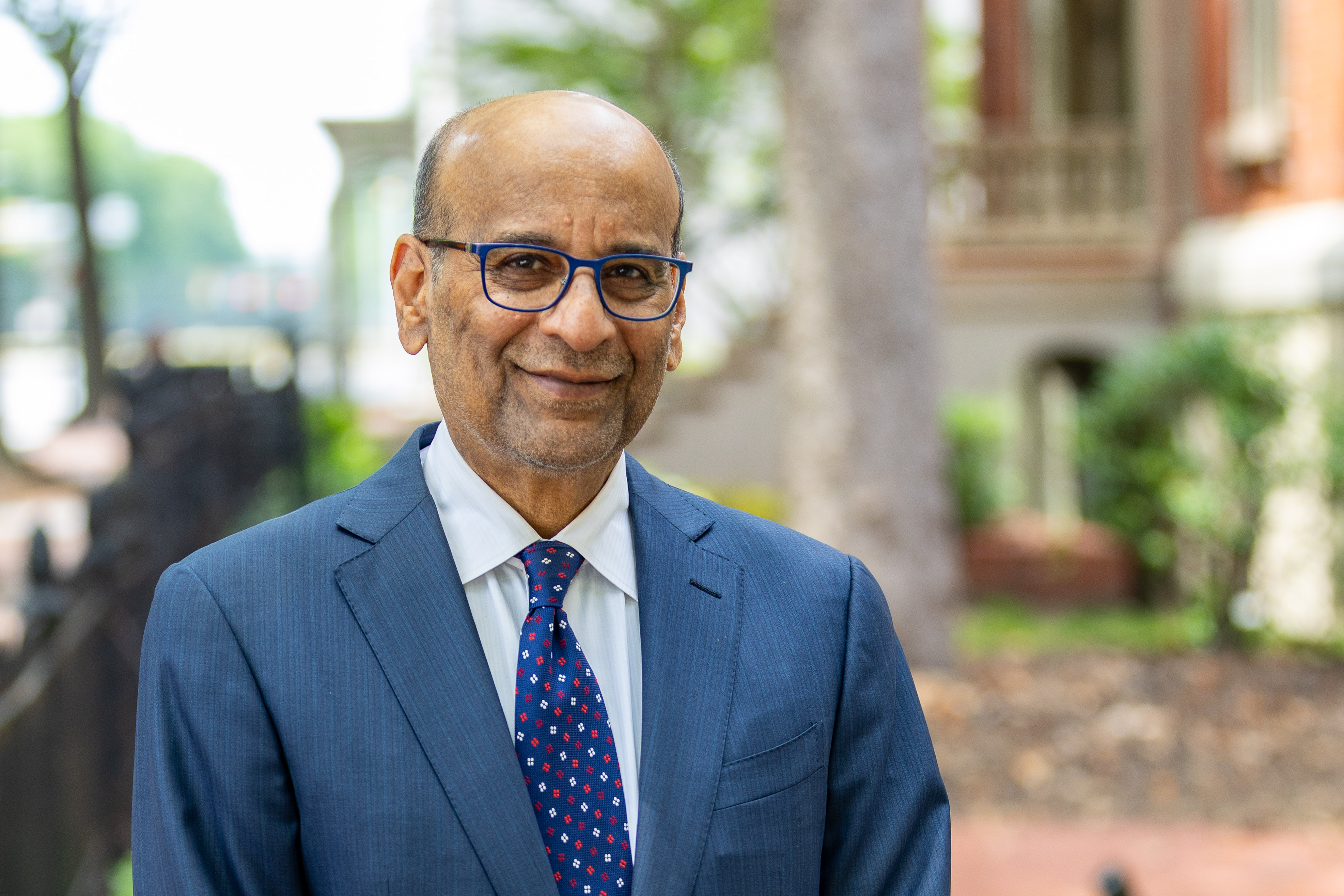
After completing his residency training in the Department of Neurosurgery in 1982, Raj Narayan, M.D., grew to become one of the world’s foremost authorities on traumatic brain injury. (Photo by Skip Rowland)
In the winter of 1976, Raj Narayan, M.D., boarded a Greyhound bus in Philadelphia with $8 in his pocket and all his worldly possessions packed into a single suitcase. The trip south to Richmond marked the start of a journey that would shape a pioneering neurosurgical career spanning continents. And it began with a cold call.
Just weeks earlier, Narayan had arrived in the United States after leaving behind a coveted spot in the most prestigious neurosurgery training program in his home country of India. The move was bold and uncertain.
“Leaving India was a risk,” Narayan said. “I had no idea where I was going to land.”
But he had a name: Donald Becker, M.D., then chair of the Department of Neurosurgery at the VCU School of Medicine. Narayan had devoured Becker’s research and, without any connections, phoned his office to request an interview. To his surprise, Becker agreed to meet him. There were no promises, only a conversation.
That’s how Narayan found himself walking from a bus stop in downtown Richmond to West Hospital, suitcase in hand, for what was meant to be a 30-minute interview. Ninety minutes later, Becker had found in Narayan exactly what he needed for a newly funded National Institutes of Health grant on head injury research: an energetic, determined problem-solver.
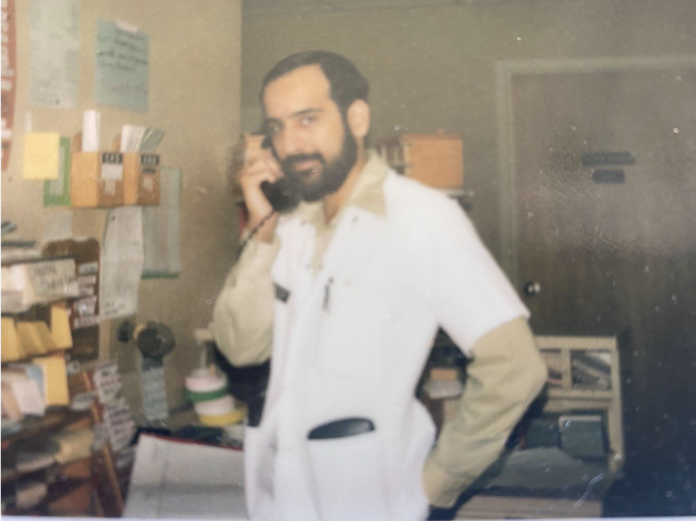
MCV, circa 1977: Raj Narayan, M.D., starts a journey that would shape the future of neurosurgery. In June, Narayan returned to the MCV Campus as the C.C. Coleman Young Visiting Professor for the Department of Neurosurgery’s John D. Ward Resident Research Day. (Submitted photo)
"Dr. Becker told me that the job would involve a lot of scut work,” Narayan said. “I barely understood the meaning of that term, but desperate for a job, I told him that I would be happy to do scut.”
So Narayan became the school’s first Head Injury Fellow. He developed forms to track traumatic brain injury cases, coordinated with the neurosurgery team and around the clock absorbed everything he could from rounds and research. Not having a place to live, Narayan spent his first six months sleeping in Randolph-Minor Hall on the MCV Campus. In a small room with a single bed and a shared hallway bathroom, he remembers being startled awake by the sound of his pager, then rushing to help the nurses and residents with head injury cases.
“Dr. Harry Young used to tell me that I could prepare myself for neurosurgery by sleeping on a bed of nails. But in those days, there was hardly any opportunity for sleep,” he said. “So for six months, I was Johnny-on-the-spot for every head injury that came through the doors,” he said.
That on-the-ground experience didn’t go unnoticed. Becker soon offered him an opening in the highly sought-after neurosurgery residency program, where Narayan immersed himself in a culture of rigor, innovation and camaraderie. He credits the experience as foundational.
“That period of time, although incredibly demanding, built the rest of my career,” Narayan said. “I had a courtside seat to see how a neurosurgery program is built.”
Leading by example
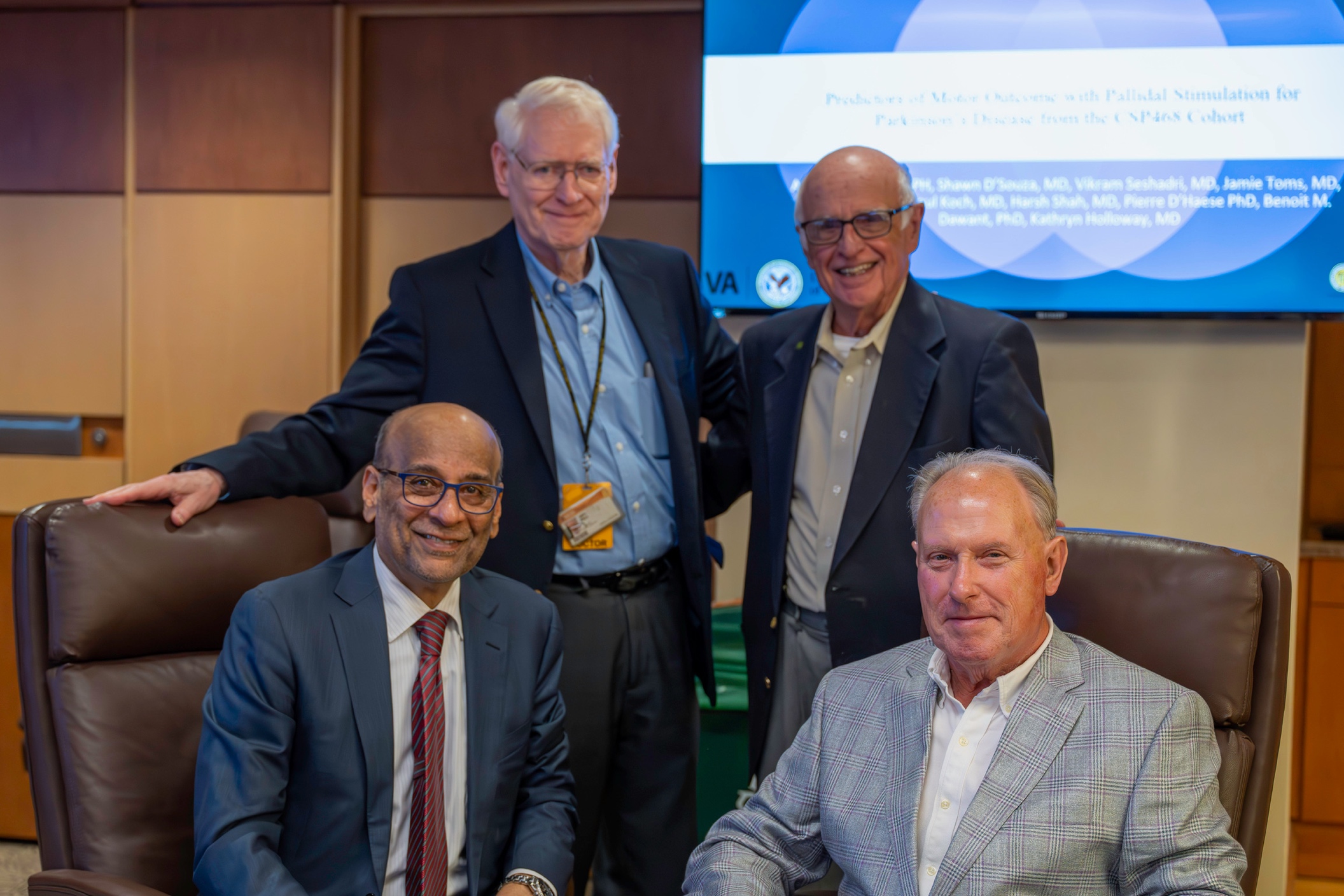
(From left) Raj Narayan, M.D., John D. Ward, M.D., Harold Young, M.D., and John Povlishock, Ph.D., reunite during the Department of Neurosurgery Resident Research Day. (Submitted photo)
He trained under giants in the field, starting with Harold Young, M.D., then vice chair of the department, who Narayan recalls was “in the trenches with us,” ensuring every case was managed with precision. John D. Ward, M.D., brought steadiness in a busy, high-stakes environment. John Povlishock, Ph.D., offered scientific mentorship that shaped Narayan’s research mindset. The late Doug Miller, M.D., was a model surgeon-scientist who left a lasting impression. Becker, who died in 2020, was a gifted motivator who Narayan remembers as “full of life and an inspirational leader.”
Narayan completed his residency in 1982 and then embarked on a three-year fellowship at the NIH, delving into brain tumor research, a field that had captivated him from the start. In 1985, when he joined the faculty of Baylor College of Medicine in Houston, Narayan initially set out to concentrate on tumors. Yet, the profound impact of his earlier work in head injury on the MCV Campus shaped his trajectory, propelling him to develop a major NIH-funded head injury research program.
After a decade in Houston, Narayan went on to lead departments of neurosurgery at three major institutions: Temple University, University of Cincinnati and Northwell Health in New York. At each stop, he built programs grounded in the values he honed during his formative years in Richmond: clinical excellence, research and mentorship. Now, at age 72 and as Chairman of the Board of the Vellore Christian Medical College Foundation in New York, Narayan continues to lead by example.
Over the decades, he has become one of the world’s foremost authorities in traumatic brain injury, holding two U.S. patents on technologies that have significantly improved patient outcomes. Yet despite the accolades and the global reach of his work, Narayan never lost touch with the department that first took a chance on him.
“We’re honored to welcome Dr. Narayan back to VCU. His return is a meaningful reminder of the enduring impact one individual can have on a field, an institution and generations of patients and trainees,” said David Limbrick, M.D., Ph.D., chair of the Department of Neurosurgery and a 2001 graduate of the School of Medicine. “His leadership, scholarship and deep commitment to patient care have shaped the field of neurosurgery in profound ways, and we’re grateful for the lasting connection he continues to share with our department.”
‘It all started here’
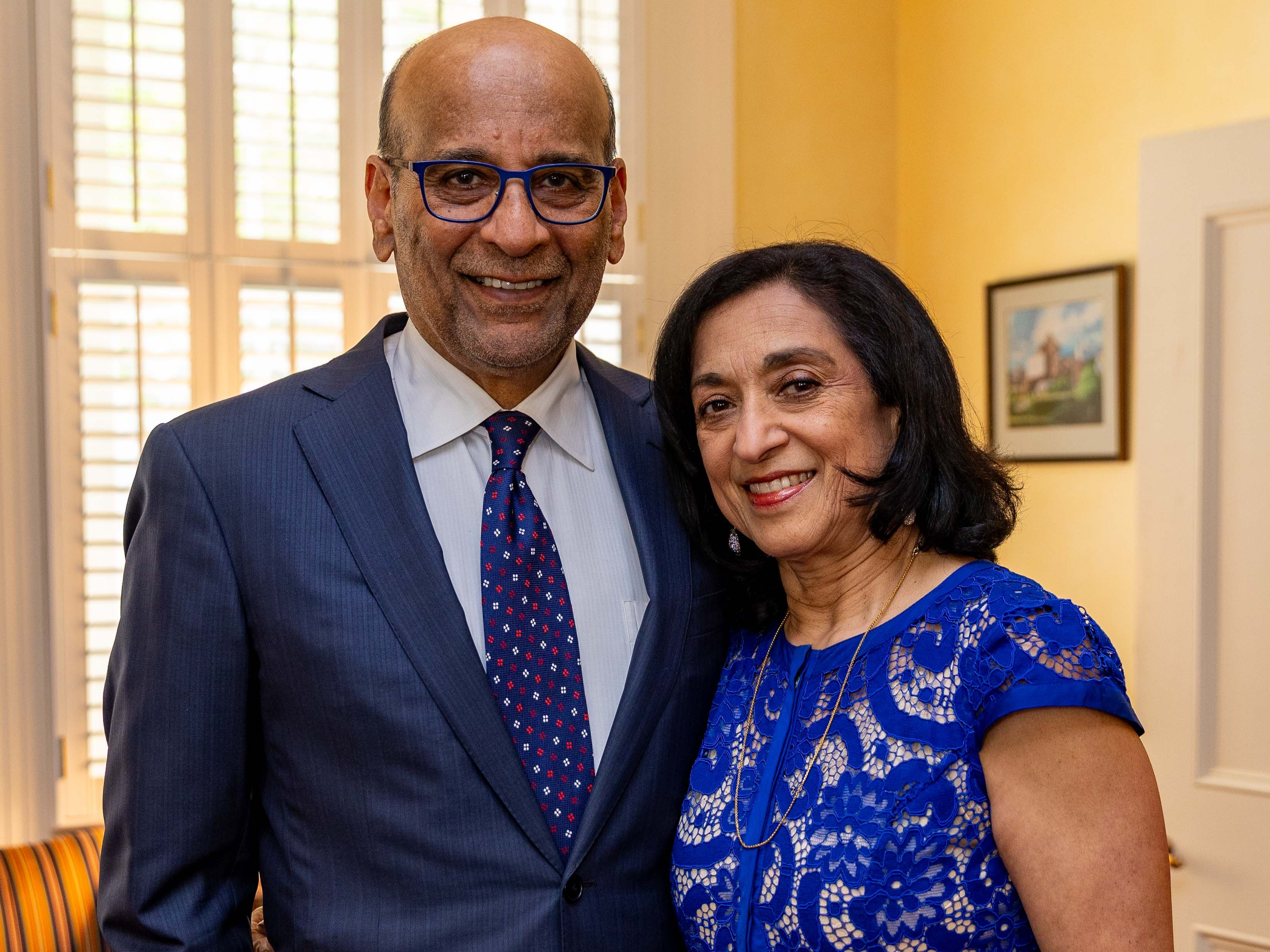
A brain trust built on family and the MCV Campus: Both Raj Narayan, M.D., a neurosurgeon, and his wife Tina Narayan, M.D., a pediatric neurologist, completed their residency training at VCU School of Medicine. (Photo by Skip Rowland)
In June, Narayan returned to the MCV Campus as the C.C. Coleman Young Visiting Professor for the Department of Neurosurgery’s John D. Ward Resident Research Day. Joined by his wife, Tina – a pediatric neurologist who also completed her pediatric residency training in 1982 on the MCV Campus – the couple revisited the institution that had shaped their careers and lives.
“The sense of mission here hasn’t changed,” Narayan said. “This program remains dedicated to exceptional clinical care and training people who will not only practice ethical and outstanding neurosurgery, but will advance the field.”
That distinction matters deeply to him. While he acknowledges the financial pressures that often pull today’s neurosurgery graduates toward more lucrative spinal practices, he encourages young surgeons to think boldly and pursue the work that ignites their intellectual curiosity.
“Historically, neurosurgery has grown because it emphasized research and development,” he said. “If we lose that, we risk becoming a trade rather than a profession.”
Fortunately, Narayan sees reasons for optimism at his alma mater.
“I’m extremely encouraged by how well our program is doing,” he said. “This institution has been the birthplace of many innovations, not only in surgery, but in so many areas of medicine.”
Nearly five decades after arriving with little more than determination and a name in his pocket, Narayan walked once again through the MCV Campus. This time, he carried something entirely different: a lifetime of knowledge, and the quiet satisfaction of returning to where it all began.
“It all started here,” Narayan said. “And I’ll always be grateful for that.”
To learn more about supporting the Department of Neurosurgery, contact Bernadette O'Shea, senior director of development, at osheab@vcu.edu.
In the winter of 1976, Raj Narayan, M.D., boarded a Greyhound bus in Philadelphia with $8 in his pocket and all his worldly possessions packed into a single suitcase. The trip south to Richmond marked the start of a journey that would shape a pioneering neurosurgical career spanning continents. And it began with a cold call.
Just weeks earlier, Narayan had arrived in the United States after leaving behind a coveted spot in the most prestigious neurosurgery training program in his home country of India. The move was bold and uncertain.
“Leaving India was a risk,” Narayan said. “I had no idea where I was going to land.”
But he had a name: Donald Becker, M.D., then chair of the Department of Neurosurgery at the VCU School of Medicine. Narayan had devoured Becker’s research and, without any connections, phoned his office to request an interview. To his surprise, Becker agreed to meet him. There were no promises, only a conversation.
That’s how Narayan found himself walking from a bus stop in downtown Richmond to West Hospital, suitcase in hand, for what was meant to be a 30-minute interview. Ninety minutes later, Becker had found in Narayan exactly what he needed for a newly funded National Institutes of Health grant on head injury research: an energetic, determined problem-solver.
MCV, circa 1977: Raj Narayan, M.D., starts a journey that would shape the future of neurosurgery. In June, Narayan returned to the MCV Campus as the C.C. Coleman Young Visiting Professor for the Department of Neurosurgery’s John D. Ward Resident Research Day. (Submitted photo)
"Dr. Becker told me that the job would involve a lot of scut work,” Narayan said. “I barely understood the meaning of that term, but desperate for a job, I told him that I would be happy to do scut.”
So Narayan became the school’s first Head Injury Fellow. He developed forms to track traumatic brain injury cases, coordinated with the neurosurgery team and around the clock absorbed everything he could from rounds and research. Not having a place to live, Narayan spent his first six months sleeping in Randolph-Minor Hall on the MCV Campus. In a small room with a single bed and a shared hallway bathroom, he remembers being startled awake by the sound of his pager, then rushing to help the nurses and residents with head injury cases.
“Dr. Harry Young used to tell me that I could prepare myself for neurosurgery by sleeping on a bed of nails. But in those days, there was hardly any opportunity for sleep,” he said. “So for six months, I was Johnny-on-the-spot for every head injury that came through the doors,” he said.
That on-the-ground experience didn’t go unnoticed. Becker soon offered him an opening in the highly sought-after neurosurgery residency program, where Narayan immersed himself in a culture of rigor, innovation and camaraderie. He credits the experience as foundational.
“That period of time, although incredibly demanding, built the rest of my career,” Narayan said. “I had a courtside seat to see how a neurosurgery program is built.”
Leading by example
(From left) Raj Narayan, M.D., John D. Ward, M.D., Harold Young, M.D., and John Povlishock, Ph.D., reunite during the Department of Neurosurgery Resident Research Day. (Submitted photo)
He trained under giants in the field, starting with Harold Young, M.D., then vice chair of the department, who Narayan recalls was “in the trenches with us,” ensuring every case was managed with precision. John D. Ward, M.D., brought steadiness in a busy, high-stakes environment. John Povlishock, Ph.D., offered scientific mentorship that shaped Narayan’s research mindset. The late Doug Miller, M.D., was a model surgeon-scientist who left a lasting impression. Becker, who died in 2020, was a gifted motivator who Narayan remembers as “full of life and an inspirational leader.”
Narayan completed his residency in 1982 and then embarked on a three-year fellowship at the NIH, delving into brain tumor research, a field that had captivated him from the start. In 1985, when he joined the faculty of Baylor College of Medicine in Houston, Narayan initially set out to concentrate on tumors. Yet, the profound impact of his earlier work in head injury on the MCV Campus shaped his trajectory, propelling him to develop a major NIH-funded head injury research program.
After a decade in Houston, Narayan went on to lead departments of neurosurgery at three major institutions: Temple University, University of Cincinnati and Northwell Health in New York. At each stop, he built programs grounded in the values he honed during his formative years in Richmond: clinical excellence, research and mentorship. Now, at age 72 and as Chairman of the Board of the Vellore Christian Medical College Foundation in New York, Narayan continues to lead by example.
Over the decades, he has become one of the world’s foremost authorities in traumatic brain injury, holding two U.S. patents on technologies that have significantly improved patient outcomes. Yet despite the accolades and the global reach of his work, Narayan never lost touch with the department that first took a chance on him.
“We’re honored to welcome Dr. Narayan back to VCU. His return is a meaningful reminder of the enduring impact one individual can have on a field, an institution and generations of patients and trainees,” said David Limbrick, M.D., Ph.D., chair of the Department of Neurosurgery and a 2001 graduate of the School of Medicine. “His leadership, scholarship and deep commitment to patient care have shaped the field of neurosurgery in profound ways, and we’re grateful for the lasting connection he continues to share with our department.”
‘It all started here’
A brain trust built on family and the MCV Campus: Both Raj Narayan, M.D., a neurosurgeon, and his wife Tina Narayan, M.D., a pediatric neurologist, completed their residency training at VCU School of Medicine. (Photo by Skip Rowland)
In June, Narayan returned to the MCV Campus as the C.C. Coleman Young Visiting Professor for the Department of Neurosurgery’s John D. Ward Resident Research Day. Joined by his wife, Tina – a pediatric neurologist who also completed her pediatric residency training in 1982 on the MCV Campus – the couple revisited the institution that had shaped their careers and lives.
“The sense of mission here hasn’t changed,” Narayan said. “This program remains dedicated to exceptional clinical care and training people who will not only practice ethical and outstanding neurosurgery, but will advance the field.”
That distinction matters deeply to him. While he acknowledges the financial pressures that often pull today’s neurosurgery graduates toward more lucrative spinal practices, he encourages young surgeons to think boldly and pursue the work that ignites their intellectual curiosity.
“Historically, neurosurgery has grown because it emphasized research and development,” he said. “If we lose that, we risk becoming a trade rather than a profession.”
Fortunately, Narayan sees reasons for optimism at his alma mater.
“I’m extremely encouraged by how well our program is doing,” he said. “This institution has been the birthplace of many innovations, not only in surgery, but in so many areas of medicine.”
Nearly five decades after arriving with little more than determination and a name in his pocket, Narayan walked once again through the MCV Campus. This time, he carried something entirely different: a lifetime of knowledge, and the quiet satisfaction of returning to where it all began.
“It all started here,” Narayan said. “And I’ll always be grateful for that.”
To learn more about supporting the Department of Neurosurgery, contact Bernadette O'Shea, senior director of development, at osheab@vcu.edu.
A Life’s Work.
Raj Narayan, M.D., has published over 140 peer-reviewed papers, authored 64 book chapters, and co-edited Neurotrauma, which is widely considered among the major textbooks on head and spinal injury. He and his wife, Tina Narayan, M.D., live in Sands Point, New York. They have three children and recently welcomed their sixth grandchild.
Tags: