Looking back with the women of 1978
Even as they navigated changing — and often challenging — times for women in medicine, they continued to pave the way for future women medical students and physicians.
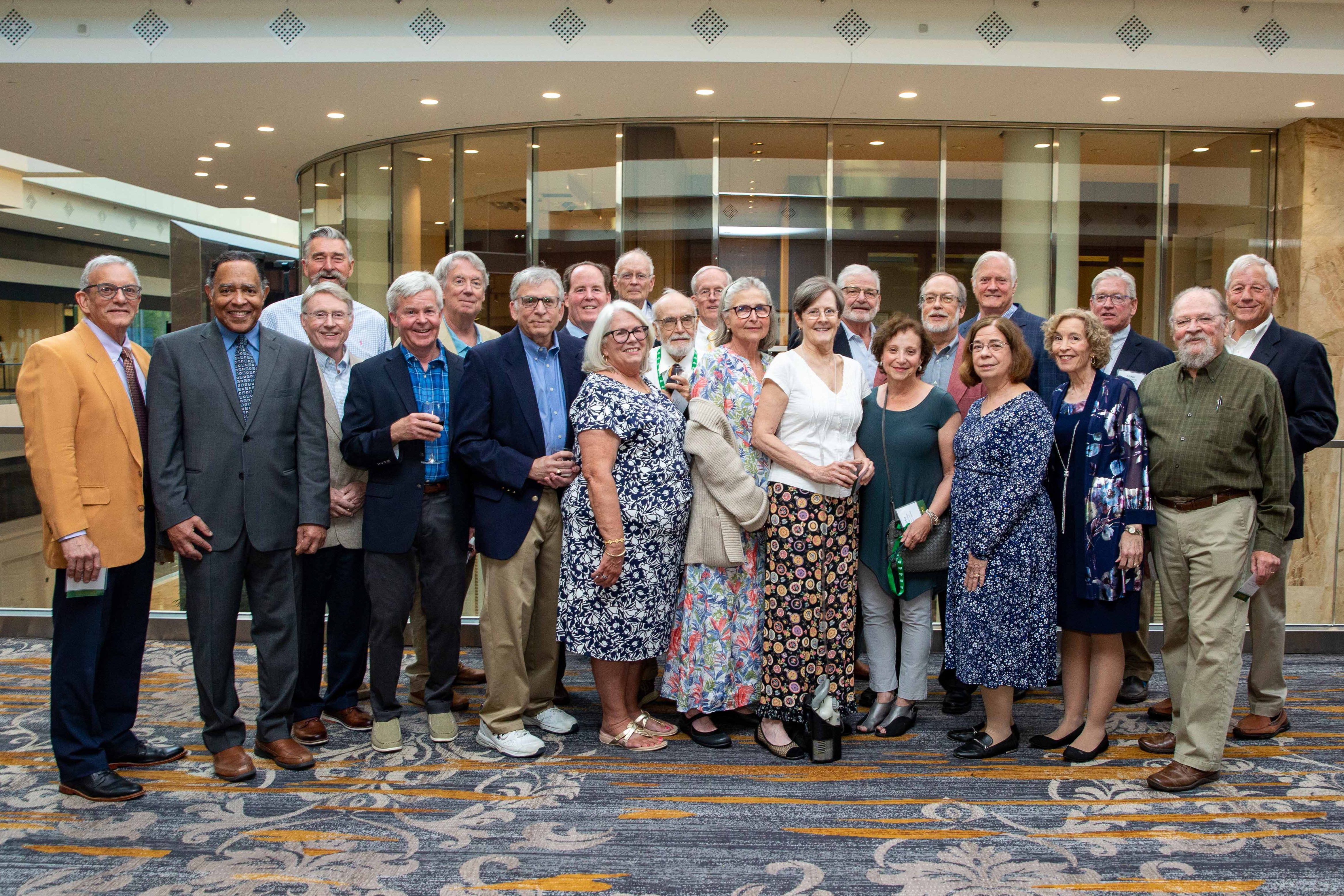
The Class of 1978 at 2023 Alumni Reunion (Photo by Skip Rowland)
This story was published in the fall 2025 issue of 12th & Marshall. You can find the current and past issues online.
Exactly 10 years before the School of Medicine’s Class of 1978 arrived on the MCV Campus, Bob Dylan released “The Times They Are a-Changin’.” He probably wasn’t thinking about women in medicine, but the description was apt.
Looking at the school’s Class of ’78 as a microcosm for what was happening in the world at large, 24% of its graduates were women. Even as they navigated changing — and often challenging — times for women in medicine, they continued to pave the way for future women medical students and physicians.
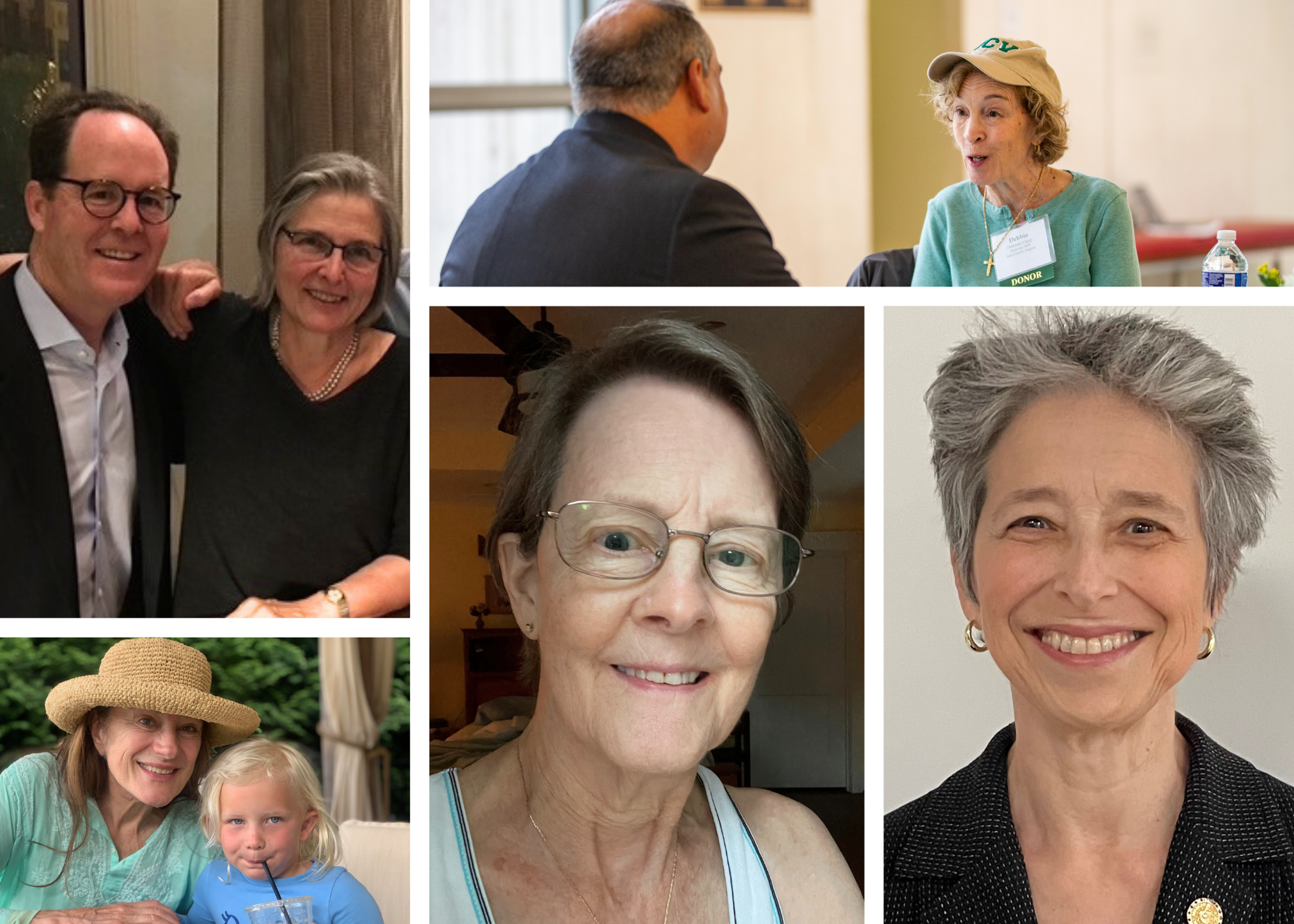
Clockwise from top left: Martha R. “Marty” Dorn, M’78, and husband John D. Scandling Jr., M’78. Deborah “Debbie” Clapp, M’78, with Dean of Medicine Arturo P. Saavedra, M.D., Ph.D. Frances Dickinson “Dickie” McMullan, M’78. Pamela S. “Pam” Douglas, M’78. Elizabeth P. Pierce, M’78.
Many of the women of ’78 went on to be pioneers in their fields. Cardiologist Pamela S. “Pam” Douglas, M’78, was the first woman president of the American Society of Echocardiography and the second woman president of the American College of Cardiology. Ophthalmologist Frances Dickinson “Dickie” McMullan, M’78, was the first woman to perform phacoemulsification and LASIK in the Atlanta area. And Martha R. “Marty” Dorn, M’78, was among the first physicians, male or female, to pursue a career in emergency medicine.
Perhaps being in the minority, gender-wise, actually helped spur some to success.
At the same time, says pediatrician Elizabeth P. Pierce, M’78, of Nashville, Tennessee, “VCU was a good fit. And the number of women made it easier.”
It’s not that there weren’t challenges within the shifting landscape of medicine, of course.
Deborah “Debbie” Clapp, M’78, of Falls Church, Virginia, recalls that when she chose her specialty, pediatrics, she often heard, “Oh, what a great field for a woman!”
“That was like fingernails on a chalkboard,” laughs Clapp, whose career spanned more than four decades. But administrators were very supportive, she says, and class members bonded well as time went on.
In fact, “tight-knit” is a word that often comes up with Class of ’78 alumnae. “We were a really good class,” says rheumatologist Deborah Litman, M’78, of Chevy Chase, Maryland, who still practices part-time. “People were welcoming and warm.”
Among the reasons Litman chose VCU is that it offered individual interviews. She recalls one interview with another school: “I was sitting there with 10 men. One of the questions was, ‘Are you going to have children?’ Nobody asked that question at VCU.”
McMullan already had experienced being in the minority — as a woman — as part of the University of Virginia’s first undergraduate coed cohort. And Douglas had been accepted by her undergraduate school, Princeton, the second year it was open to women. So medical school was not substantially different for them in that regard.
McMullan — who followed in the footsteps of her father, Francis H. “Moon” McMullan, M’51, H’52, to become a physician — still performs surgery on a part-time basis in Atlanta. She recalls one School of Medicine professor “telling us we belonged at home,” but the women of ’78 eventually won him over. “At that point, I felt he and his staff gave us undivided attention. There was no outward animosity or resistance.
“We were not fist-in-the-air feminists,” she says. “We were not there to make a statement. We were there to become physicians.”
The School of Medicine admitted its first female medical students, three among a class of 42, in 1918.
The numbers began to surge in the late ‘70s and early ‘80s — as was evident with the Class of ’78 — when the U.S. Bureau of Labor Statistics began advising college career counselors to expand the range of recommended occupations for women.
Before that time, Clapp says, it seemed women basically had three career choices: teacher, nurse or secretary.
And, Litman adds, once women achieved their M.D. degrees, it seemed there were three options: Try to do it all … give up medicine … or don’t have children.
Of the six women in this ’78 sampling, all were married, mostly to fellow physicians (including Dorn to classmate John D. Scandling Jr., M’78), and three had children. Some recall the compulsion to be superwomen, to “do it all,” while others describe simply wanting to do the best they could do, be the best they could be in their chosen profession.
None of them gave up on medicine.
Some of their journeys were “straight shots,” whereas others experienced more nonlinear paths.
Dorn, who originally wanted to study ancient Egyptian and Latin, started out in internal medicine before becoming an emergency physician with Stanford. Shifting gears about two decades later, she was hired as medical director for a large Santa Clara refugee clinic — just weeks before 9/11, which put the clinic out of business. Inspired by prior experiences to switch to geriatrics, she completed a fellowship in 2010, practiced for two years and now is retired in Palo Alto, California.
Pierce had planned to pursue developmental economics in underdeveloped areas before turning to medicine. Her interest in family practice turned to pediatrics halfway through medical school. After nearly 30 years in practice, she was forced to retire from seeing patients due to a lung disease of unknown origin. But she stayed active on the business side as a pediatric medical director for Vanderbilt Health Affiliated Network — and, just this past spring, received a successful lung transplant.
And Douglas, who lives in Durham, North Carolina, was studying rheumatology at the NIH when a male colleague noted the need for more women in cardiology. Her chosen career as an academic physician-scientist culminated in a 21-year (so far) tenure at Duke University, where she continues to hold a distinguished professorship and is excited to be in the early stages of a large new NIH grant.
“There is some pressure to be a role model,” Douglas says of her experience. “I had a special chance. And with that came a special responsibility.”
The School of Medicine’s incoming Class of 2029 numbers 184 students, 114 — or 62% — of whom are women.
Sure, the times are still a-changin’. But the tradition of strong, accomplished female medical students and physicians that began in 1918 — and that has endured throughout the years — is a living, flourishing legacy.
This story is the first in an occasional series spotlighting different classes in the medical school. What makes your class special? Email us at MedAlum@vcu.edu.