Networks that heal
To translate discovery into care, the school of medicine's senior associate dean for research champions systems thinking, team science and training the next generation.
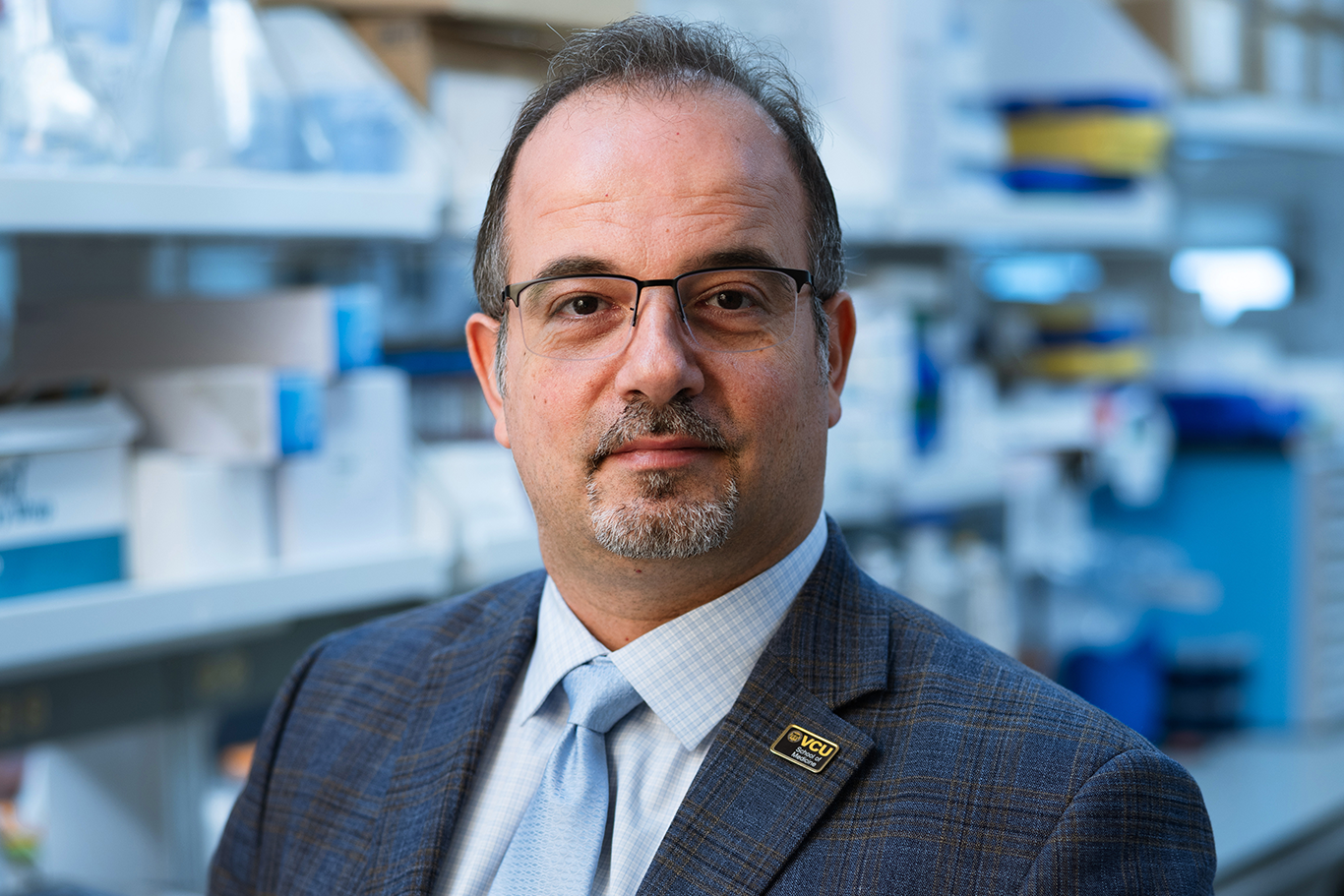
Fadi N. Salloum, Ph.D. (Photography by Daniel Sangjib Min, MCV Foundation)
This story was published in the fall 2025 issue of 12th & Marshall. You can find the current and past issues online.
When people picture a researcher, they often see a lone figure hunched over a bench or microscope, focused on a single hypothesis. It’s a narrow image — methodical, deductive, solitary. Fadi N. Salloum, Ph.D., a 2005 alumnus and senior associate dean for research at the VCU School of Medicine, wants us to imagine something else: a network.
“For me, an organ is never truly independent within an organism,” says Salloum, who holds the Natalie N. and John R. Congdon Sr. Endowed Chair in Cardiology at the VCU Health Pauley Heart Center. “So why should the people who study them be any different?”
His answer is practical as well as philosophical. Salloum builds teams that mirror the body’s complexity so that bench discoveries don’t stop on the pages of a medical journal but travel — via deliberate translation, rigorous studies and cross-disciplinary design — into tests, trials and treatments that reach patients.
That bilingual fluency — as comfortable in the lab as in asking clinical care questions — turns ideas into therapies that matter. It’s why Salloum helped lead the School of Medicine’s recent effort to reimagine the basic health sciences and why colleagues call him a connector: someone who widens the scope of questions asked, the number of people at the table and the pathways that carry discovery to the bedside.
That philosophy has guided Salloum’s own path from a graduate student who arrived in Richmond from Beirut nearly three decades ago to a faculty leader whose fingerprints are visible across VCU’s research enterprise. What began as an initial interest in heart surgery evolved into a fascination with the creative possibilities of science — and with how systems-level thinking and team science can galvanize seemingly disparate ideas into collective impact.
A different kind of cardiologist
Salloum came to the MCV Campus drawn by stories of pioneers in cardiothoracic surgery. At the time, he had “zero exposure” to research back home in Lebanon. But while navigating the logistics of seeking higher education in the U.S. on a student visa, he stumbled into a lab, and into a new way of thinking about medicine.
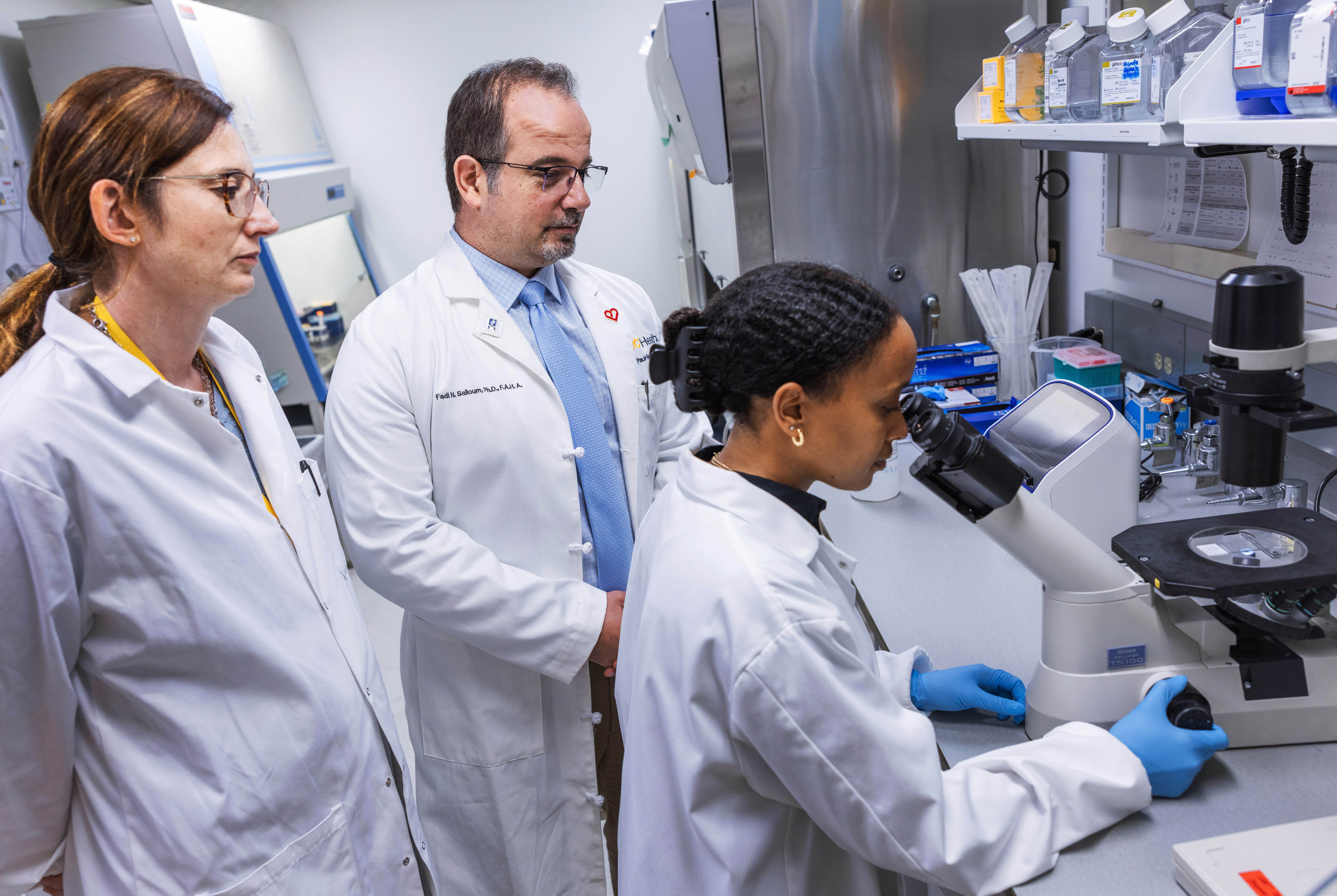
Senior lab and research manager Eleonora Mezzaroma, Ph.D. (left), and Salloum (center) work with Nigeste Carter, a fifth-year doctoral candidate in the Department of Pharmacology and Toxicology, whose research explores how chemotherapy affects the heart.
“At first, you’re mastering techniques and learning from people who’ve been doing this a long time,” he says. “Then you begin asking why: Why do some people have a heart attack and go on without further issues while others develop long-term problems despite receiving similar care and medical treatment?” That curiosity — and his habit of sitting in on every grand rounds and cardiology conference he could — soon pushed him beyond the immediate aftermath of cardiac events to the underlying mechanisms that connect heart disease with broader physiologic systems. In research, he discovered an unexpected creative freedom.
“I found myself equally excited by asking new questions and then building ways to answer them,” he says.
That openness led him to pioneer a technique at VCU that allowed his lab to study the long-term effects of heart attacks and to explore different causes of heart failure, including non-ischemic forms not tied to heart attack. It also fueled his role in co-founding the HFpEF Summit — an annual forum uniting basic, translational and clinical researchers nationwide to address Heart Failure with Preserved Ejection Fraction, the syndrome now recognized as the most common form of heart failure in women and older adults.
“Bringing people together to share perspectives changed the conversation,” he says. “You start to see possibilities you couldn’t see working alone.”
Reimagining the basic health sciences
Salloum’s systems-first outlook also shaped his role in one of the school’s most consequential recent initiatives: a reimagining of the basic health science enterprise to better align research around common themes.
It was a task for which he was well-prepared. In his previous position as associate chair for research in the Department of Internal Medicine, Salloum mentored both clinical and basic science faculty and encouraged collaborations across divisions, departments and schools — steadily working to break down traditional silos.
“Clinical departments had already adopted service lines that cut across specialties,” Salloum explains. “The basic health sciences needed a similar horizontal approach.”
He saw how faculty in disparate departments were sometimes independently studying the same biological thread — take inflammation, for example. If these investigators connected, he argues, they could build programmatic projects and grants with the heft and credibility to secure larger external funding and to produce findings with greater impact for patients.
His approach is pragmatic: Plant the seeds of collaboration by creating opportunities for researchers to meet, work together for a year or two, build trust and then apply for larger, team-based grants. He points to a concrete example — researchers from the Department of Urology who explore prostate cancer partnering with investigators from VCU Massey Comprehensive Cancer Center who study the effects of treatments on other organs — to show how cross-disciplinary curiosity expands the scope of inquiry and the pool of possible funders.
Good mentors make good neighbors
Salloum believes major, team-driven science often begins with a small, well-supported step. At VCU, those steps frequently come as pilot grants — seed dollars, funded through philanthropy, and paired with structured review and mentor teams — that give junior investigators the resources and the coaching to turn a tentative idea into fundable, translational work.
“Resources with mentorship; the two together are invaluable,” he says, underscoring how the accountability of written critiques, progress reports and mentor panels helps early career faculty as well as trainees sharpen methods, anticipate pitfalls and build the preliminary data reviewers want to see.
Colleagues say that Salloum’s value as a mentor flows both from his translational fluency and a knack for developing people.
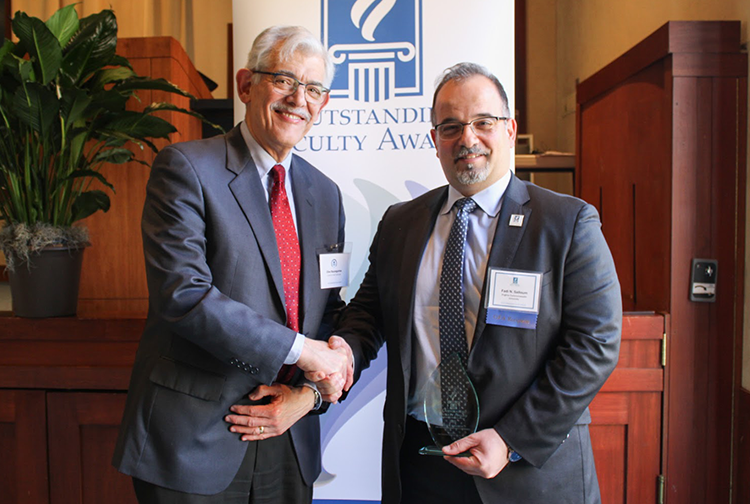
Clive M. Baumgarten, Ph.D. (left), congratulates Salloum for receiving a 2025 Outstanding Faculty Award from the State Council of Higher Education for Virginia. Baumgarten says the award — the commonwealth’s highest honor for faculty at Virginia’s colleges and universities — is a testament to the breadth of Salloum’s superb accomplishments in research, mentoring, teaching and public service. Contributed photo
Clive M. Baumgarten, Ph.D., a longtime mentor and now professor emeritus who served the School of Medicine for 42 years, describes Salloum as uniquely gifted at bridging science and medicine.
“He made himself fluent in the clinical story by attending cardiology and internal medicine seminars and then partnering with clinicians,” says Baumgarten, who served as interim chair of what was then the Department of Physiology and Biophysics before his retirement in 2021. “And he’s equally a natural teacher in both the classroom and the laboratory: enthusiastic, committed and skilled at helping students grow into independent scientists.”
That twin emphasis — rigor plus openness — was exactly what Teja Devarakonda, M.D., Ph.D., found in Salloum’s lab while a student in the School of Medicine’s Medical Scientist Training Program.
“Dr. Salloum found the perfect balance of imparting rigor and discipline to his mentees, while allowing for the individual mentee to develop independently into their own researcher,” says Devarakonda, who earned his M.D. and Ph.D. in physiology and biophysics in 2022 and is now a surgical resident at the Northwestern University Feinberg School of Medicine. “He was faithful to discipline and methodology but also open to follow the idea as things changed. Once I learned the foundational principles of sound methods, I could start thinking outside the box and see where the experiment takes me.”
From that foundation, Devarakonda says he learned to spot clinically relevant basic science problems and to design straightforward experiments that answer bedside questions. He also credits Salloum with a lesson outside the lab that matters in medicine: leadership.
“Pursuing a surgical residency isn’t the usual path for an M.D.-Ph.D. student, but working with Dr. Salloum taught me how to lead teams — to inspire teammates, organize people around a goal and get results. That ability to motivate and translate science into action reaches far beyond the lab.”
In his new appointment as the medical school’s senior associate dean for research, Salloum plans to strengthen ties across the school’s leadership, including senior associate deans, department chairs and educational leaders, so research can more seamlessly advance clinical care and training. Though his title focuses on research, he maintains a portfolio in education and stresses that the missions are interdependent.
“I’m not the senior associate dean for education,” he says, “but I want to help with that mission the same way I’d welcome their input into research.”
His goals are both cultural and operational: Foster horizontal programs that cross departmental boundaries, expand pilot and bridge funding, and institutionalize mentorship teams to shepherd early career investigators. He wants the School of Medicine to be a place where a clinician with a question about a patient can walk down the hall and find a basic scientist eager to collaborate, and vice versa.
A leader who widens the lens
Salloum’s work is a reminder that excellence in biomedical science today is as much about relationships as it is about techniques. Rigor remains central (“thinking like a real scientist,” he says), but the questions worth asking increasingly require teams — across departments, across disciplines and across the arc from bench to bedside.
As senior associate dean for research, Salloum is positioning VCU to ask those larger questions and to build the networks that will answer them. For him, that’s not just good science; it’s a better kind of care.