Communicating care: Medical student organization prepares future doctors to connect with Spanish-speaking patients
Founded earlier this year, the Medical Spanish at VCU student interest group combines language learning and service with preclinical medical education.
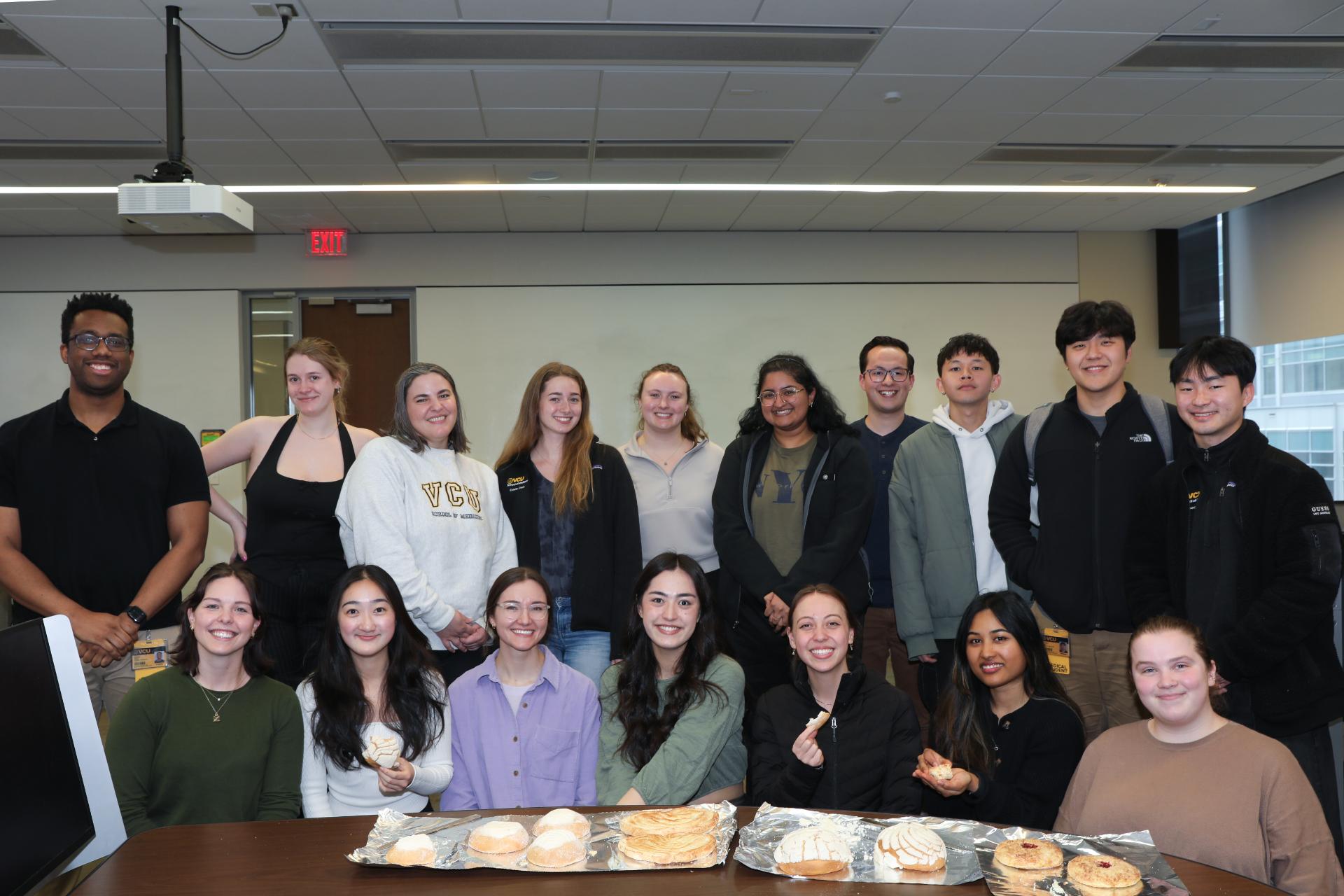
Members of the Medical Spanish at VCU student interest group meet twice a month to practice their language skills in a medical context (Photo by Arda Athman)
On a Friday in early March, around 20 students trickled into one of the McGlothlin Medical Education Center’s many learning studios, eager to review the anatomy terms they had recently learned in a recent preclinical gastroenterology lecture. It was a typical student-led study session, except for one aspect — it was conducted entirely in Spanish.
While sampling an assortment of Latin American pastries, the first- and second-year students met for the fourth session of Medical Spanish at VCU, a student interest group (SIG) founded just a couple of months earlier. Every few weeks, the group meets to review case studies, vocabulary and cultural nuances, all with the goal of increasing future physicians’ ability to communicate and connect with Spanish-speaking patients.
“It’s exciting to see how many people are interested in an initiative like this,” M1 Julia Ball, founder of the group, said. “We’ve had great turnout so far and received really helpful feedback about what they want to learn. It inspires me to grow the organization and see where we can take it.”
Bridging the language gap
More than 100,000 Virginians speak Spanish as their first language, with limited English proficiency, and Ball has seen firsthand how a language barrier can hinder someone’s ability to seek and receive medical care. As an undergraduate student at the University of Virginia, Ball worked as an EMT in neighboring Fluvanna County, a small, rural community, and she was often the only person on her squad who could communicate with Spanish-speaking patients. Ball, who began learning Spanish in middle school and lived in Spain for a year, said she even took calls from her colleagues when she was off duty to help translate.
“In emergency situations, there isn’t always time to call a telehealth center and try to get someone that speaks Spanish on the line,” Ball said. “That was the first time I really saw the need for medical professionals who can communicate with patients in their own language.”
With experience interpreting for patients at volunteer clinics and a desire to use her Spanish skills in daily life again, Ball began brainstorming with her peers about ways to incorporate Spanish into their education. She reached out to Edgar Rodas, M.D., an associate professor in the Department of Surgery who practices in both English and Spanish, to propose a SIG centered on exposing students to Spanish in a medical context.
Rodas, who's originally from Ecuador and now serves as faculty advisor to Medical Spanish at VCU, said he immediately saw the value in a group like this. A native Spanish speaker himself, Rodas said he has consistently used his language skills throughout his medical training and career in the U.S. Speaking with patients in their native language, he said, does more than improve communication — it forges a connection between patient and physician.
“I think being able to speak Spanish has allowed me to have more empathy for my patients and show them that we really care about them,” Rodas said. “When I walk into a room and switch to Spanish, I see their eyes light up, become more comfortable and know that I will address their concerns immediately.”
Classroom to community
To make the SIG meetings accessible to the greatest number of students, Medical Spanish at VCU meetings are split into beginner and advanced sessions on an alternating basis. During beginner sessions, participants focus primarily on medical vocabulary, including anatomy, common health conditions, and medical devices. Advanced sessions, on the other hand, are conducted entirely in Spanish. Students learn to perform a basic physical exam, explore case studies on common medical conditions and translate the topics they are learning in the preclinical curriculum.
In addition to teaching the ins and outs of medical communication, the group also highlights cultural nuances when working with Spanish-speaking patients. One important consideration, Ball said, is the difference between common English and Spanish idioms. For example, saying something “costs an arm and a leg” may be taken literally by a patient, because the Spanish idiom equivalent is “costar un ojo de la cara,” which translates to “costs an eye of the face.”
“Learning Spanish in this context is definitely a different process than learning Spanish to be conversational,” Ball said. “You have to be very direct in what you’re saying, because you’re in a heightened environment and don’t want to be misunderstood.”
Regardless of the fluency level, Ball and other co-leaders try to make the lessons fun. They integrate games like Simon Says and trivia, and often offer Latin American food like salsa, queso and, most recently, an assortment of “pasteles."
“My goal is to make it feel casual. No one wants to go to another lecture after already attending four hours of mandatory lectures that day,” Ball said. “When people are engaged and having fun with the material, that’s the sweet spot.”
For fellow M1s and advanced session attendees Estelle Craib and Vrinda Deshpande, the casual setting makes expanding on the Spanish they learned in high school a “stress free” process.
“There’s no embarrassment in getting something wrong, because we aren’t being graded in any way,” Craib said. “Everyone's here because they want to be here and there’s no incentive other than wanting to communicate better with patients.”
Motivated to join the group by the encounters she’s had with Spanish-speaking patients while shadowing VCU Health physicians, Craib said she believes being able to communicate with future patients in their native language will help her “build rapport” with them. Deshpande, who hopes to work with underserved communities, agreed, and said that learning Spanish is a way to meet patients where they are.
“It was always a skill I wanted to pick back up,” Deshpande said. “Being able to integrate it into my education and learn how to use it in a medical context fit my needs perfectly.”
As she looks forward to the future of the SIG, Ball said she is excited to find more opportunities for SIG members to use their Spanish skills in medical settings and hopes to collaborate with local organizations that provide care to Spanish-speaking populations.
“Communicating with someone in their language can help break down that patient-provider barrier,” Ball said. “Even if you only know a little bit, it shows patients that you care and are an ally in their health.”
Send us your stories!
The School of Medicine communications team is always looking to highlight student success, faculty achievement, cutting-edge research and innovative initiatives around the MCV Campus. If you have an idea for a story, please submit your pitch to laura.ingles@vcuhealth.org.
On a Friday in early March, around 20 students trickled into one of the McGlothlin Medical Education Center’s many learning studios, eager to review the anatomy terms they had recently learned in a recent preclinical gastroenterology lecture. It was a typical student-led study session, except for one aspect — it was conducted entirely in Spanish.
While sampling an assortment of Latin American pastries, the first- and second-year students met for the fourth session of Medical Spanish at VCU, a student interest group (SIG) founded just a couple of months earlier. Every few weeks, the group meets to review case studies, vocabulary and cultural nuances, all with the goal of increasing future physicians’ ability to communicate and connect with Spanish-speaking patients.
“It’s exciting to see how many people are interested in an initiative like this,” M1 Julia Ball, founder of the group, said. “We’ve had great turnout so far and received really helpful feedback about what they want to learn. It inspires me to grow the organization and see where we can take it.”
Bridging the language gap
More than 100,000 Virginians speak Spanish as their first language, with limited English proficiency, and Ball has seen firsthand how a language barrier can hinder someone’s ability to seek and receive medical care. As an undergraduate student at the University of Virginia, Ball worked as an EMT in neighboring Fluvanna County, a small, rural community, and she was often the only person on her squad who could communicate with Spanish-speaking patients. Ball, who began learning Spanish in middle school and lived in Spain for a year, said she even took calls from her colleagues when she was off duty to help translate.
“In emergency situations, there isn’t always time to call a telehealth center and try to get someone that speaks Spanish on the line,” Ball said. “That was the first time I really saw the need for medical professionals who can communicate with patients in their own language.”
With experience interpreting for patients at volunteer clinics and a desire to use her Spanish skills in daily life again, Ball began brainstorming with her peers about ways to incorporate Spanish into their education. She reached out to Edgar Rodas, M.D., an associate professor in the Department of Surgery who practices in both English and Spanish, to propose a SIG centered on exposing students to Spanish in a medical context.
Rodas, who's originally from Ecuador and now serves as faculty advisor to Medical Spanish at VCU, said he immediately saw the value in a group like this. A native Spanish speaker himself, Rodas said he has consistently used his language skills throughout his medical training and career in the U.S. Speaking with patients in their native language, he said, does more than improve communication — it forges a connection between patient and physician.
“I think being able to speak Spanish has allowed me to have more empathy for my patients and show them that we really care about them,” Rodas said. “When I walk into a room and switch to Spanish, I see their eyes light up, become more comfortable and know that I will address their concerns immediately.”
Classroom to community
To make the SIG meetings accessible to the greatest number of students, Medical Spanish at VCU meetings are split into beginner and advanced sessions on an alternating basis. During beginner sessions, participants focus primarily on medical vocabulary, including anatomy, common health conditions, and medical devices. Advanced sessions, on the other hand, are conducted entirely in Spanish. Students learn to perform a basic physical exam, explore case studies on common medical conditions and translate the topics they are learning in the preclinical curriculum.
In addition to teaching the ins and outs of medical communication, the group also highlights cultural nuances when working with Spanish-speaking patients. One important consideration, Ball said, is the difference between common English and Spanish idioms. For example, saying something “costs an arm and a leg” may be taken literally by a patient, because the Spanish idiom equivalent is “costar un ojo de la cara,” which translates to “costs an eye of the face.”
“Learning Spanish in this context is definitely a different process than learning Spanish to be conversational,” Ball said. “You have to be very direct in what you’re saying, because you’re in a heightened environment and don’t want to be misunderstood.”
Regardless of the fluency level, Ball and other co-leaders try to make the lessons fun. They integrate games like Simon Says and trivia, and often offer Latin American food like salsa, queso and, most recently, an assortment of “pasteles."
“My goal is to make it feel casual. No one wants to go to another lecture after already attending four hours of mandatory lectures that day,” Ball said. “When people are engaged and having fun with the material, that’s the sweet spot.”
For fellow M1s and advanced session attendees Estelle Craib and Vrinda Deshpande, the casual setting makes expanding on the Spanish they learned in high school a “stress free” process.
“There’s no embarrassment in getting something wrong, because we aren’t being graded in any way,” Craib said. “Everyone's here because they want to be here and there’s no incentive other than wanting to communicate better with patients.”
Motivated to join the group by the encounters she’s had with Spanish-speaking patients while shadowing VCU Health physicians, Craib said she believes being able to communicate with future patients in their native language will help her “build rapport” with them. Deshpande, who hopes to work with underserved communities, agreed, and said that learning Spanish is a way to meet patients where they are.
“It was always a skill I wanted to pick back up,” Deshpande said. “Being able to integrate it into my education and learn how to use it in a medical context fit my needs perfectly.”
As she looks forward to the future of the SIG, Ball said she is excited to find more opportunities for SIG members to use their Spanish skills in medical settings and hopes to collaborate with local organizations that provide care to Spanish-speaking populations.
“Communicating with someone in their language can help break down that patient-provider barrier,” Ball said. “Even if you only know a little bit, it shows patients that you care and are an ally in their health.”
Send us your stories!
The School of Medicine communications team is always looking to highlight student success, faculty achievement, cutting-edge research and innovative initiatives around the MCV Campus. If you have an idea for a story, please submit your pitch to laura.ingles@vcuhealth.org.
Interested in joining or partnering with Medical Spanish at VCU?
To learn more about learning sessions, initiatives and service opportunities, email medicalspanish.VCU@gmail.com.
Tags: