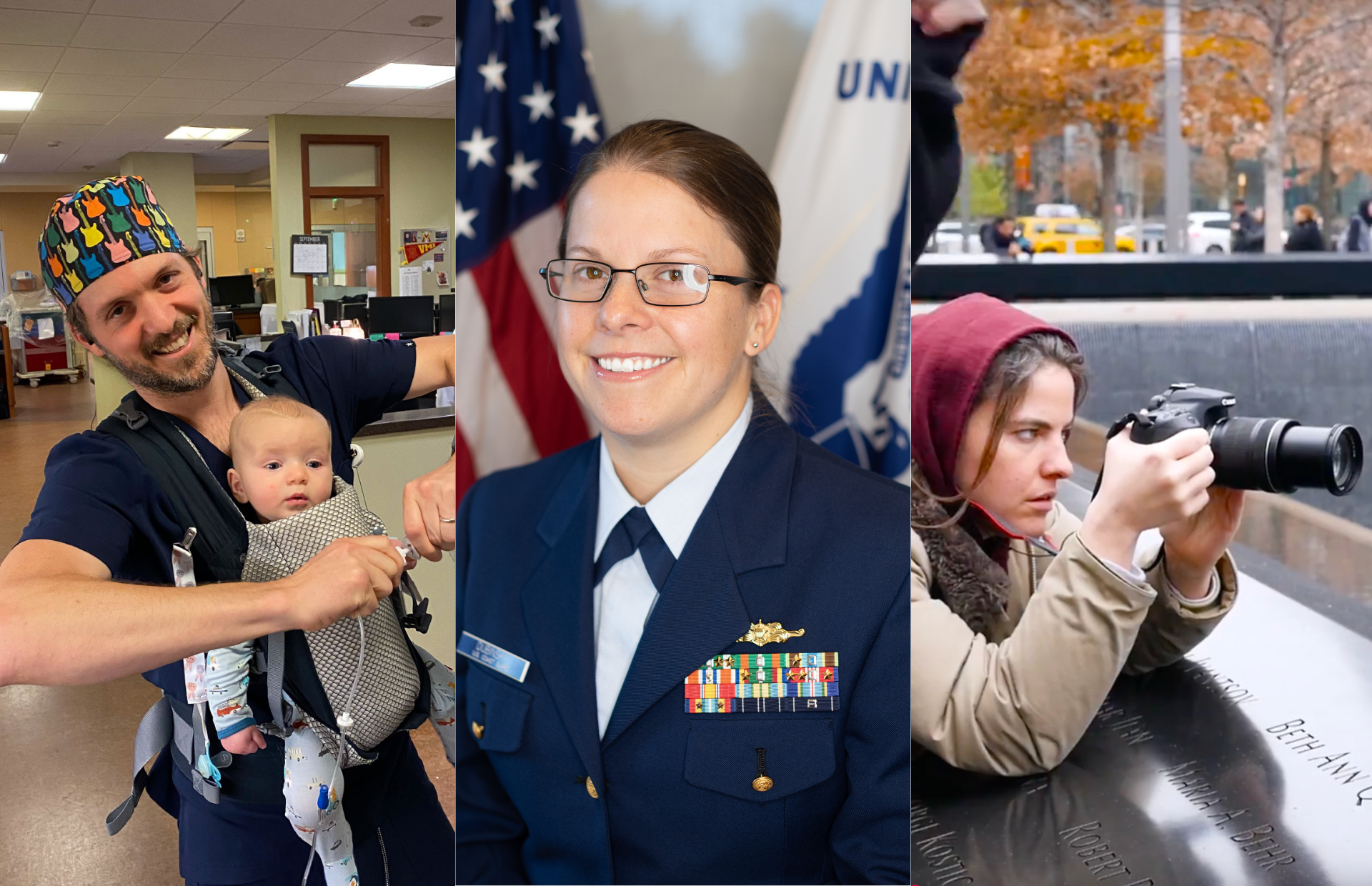
‘You learn how to put in hard work’: How sports can shape future physicians
For former collegiate student-athletes, medical school is trading one high-intensity environment for another.
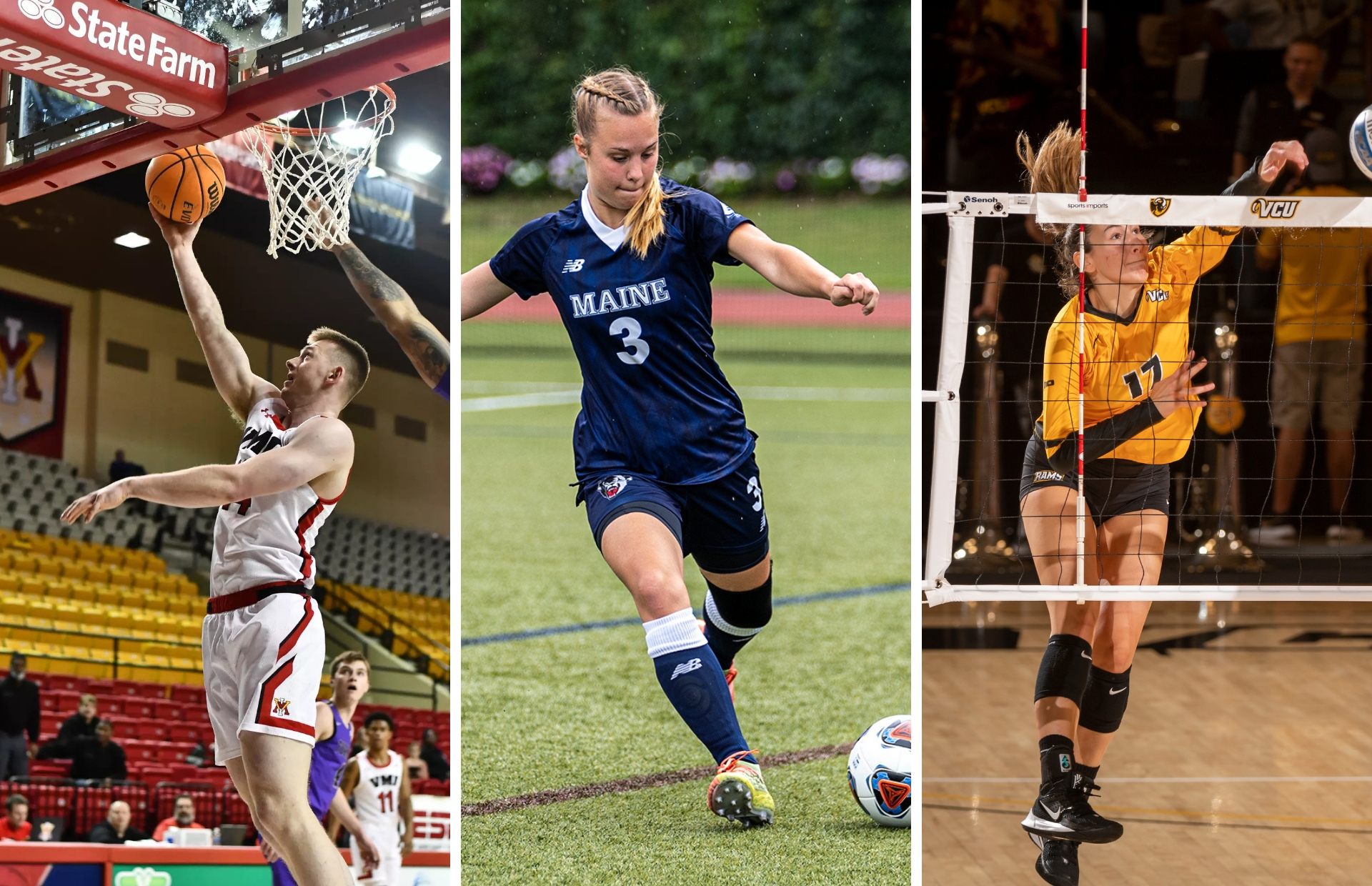
(From left) Medical students Sam Wolfe, Amanda Sandberg and Gina Tuzzolo playing for Division I collegiate teams
Nearly every hour of a Division I student-athlete’s day is accounted for. Morning workouts often start before the sun rises, and late afternoons are reserved for practice, team dinners and active recovery that can stretch into the evening.
Those experiences can teach lifelong, translatable skills, according to Mary Caldwell, D.O. As a former Division I track and field runner herself and now a sports medicine physician who works with athletes every day, Caldwell said the ability to perform under pressure, value teamwork and pick herself up after a setback prepared her for a career in medicine.
“I can never be separated from being an athlete,” Caldwell said. “I’ve been in many of my patients' shoes, and being in touch with my body and mind as a runner has helped me recognize when I need to take a step back or ask for help.”
Caldwell, an associate professor in the Department of Physical Medicine and Rehabilitation, isn’t alone in her experience. Research has found that many of the attributes necessary to be successful in high-level athletics make student-athletes particularly well-suited for medical school.
“Every single athlete, regardless of their level, has a bad day, a bad game or a bad season,” Caldwell said. “How you respond to those setbacks that shapes you and makes you wiser in whatever career you decide to pursue in the future.”
Amanda Sandberg, M.D.-Ph.D. student

M.D.-Ph.D. student Amanda Sandberg playing D1 women's soccer for the University of Maine Black Bears (Photo courtesy of Maine Athletics, Arda Athman)
Whether it's moving alone to a new country to pursue her athletic goals or committing to an eight-year, dual-doctoral program, Amanda Sandberg approaches challenges as an adventure.
“I’m not really afraid to try new things, because that’s where you find opportunity,” Sandberg said.
Soccer brought Sandberg to the U.S. from her native Sweden in 2018. Growing up in Skurup, a town of approximately 7,000 people, "almost everyone” in the small coastal community played the sport, Sandberg said. After excelling in youth leagues and winning international titles, Sandberg left her home country on a sports scholarship to the University of Maine women’s soccer team.
Living, learning and playing in a new country meant thinking on her feet, Sandberg said. As a defender, she competed at a high level while getting used to her American teammates’ alternative style of play. Off the pitch, she had to navigate an education system completely different from the one she was used to, while still focusing on her academics and thinking of her future.
Those challenges didn’t dissuade Sandberg from deciding to pursue both an M.D. and Ph.D. in the U.S., a combination of her passion for research and interest in working with others. Knowing the odds were stacked against her — less than 36% of medical schools accepted international applications in the 2025-2026 admissions cycle — Sandberg earned a master’s degree in microbiology at the University of Maine, while still playing on the team, to make herself a more competitive applicant.
“It was a little daunting to think about being in school for another eight years, but I worked so hard for this opportunity,” Sandberg said. “I’m taking it one year at a time, and I think these years are going to fly by.”
Now in the graduate phase of the Medical Scientist Training Program, Sandberg said her soccer career has helped her stay resilient through the ups and downs, both on and off the pitch.
“In sports, you learn to put in hard work, even if results don’t come right away,” Sandberg said. “It teaches you to trust the process and not let the bad days bring you down.”
Gina Tuzzolo, M3

M3 Gina Tuzzolo playing for the VCU Rams Women's Volleyball team (Photo courtesy of VCU Athletics, Arda Athman)
For Gina Tuzzolo, success comes down to one thing — effort.
Tuzzolo grew up in an athletic family with parents who encouraged her and her two brothers to try multiple sports. While both of her brothers excelled in baseball early on, it took Tuzzolo a bit longer to find her footing.
“I was really tall, but very uncoordinated,” Tuzzolo said. “I was terrible at volleyball too, but I had so much fun playing that it just stuck. It didn’t matter that I was bad at it.”
Years of hard work paid off, and by the time she graduated high school, the middle blocker and opposite hitter had broken school records, earned state and national titles and received a recruitment offer from VCU.
Pursuing medicine as a collegiate athlete was a delicate balance, Tuzzolo said. Mandatory lab sessions for her biology minor often conflicted with the team’s morning weightlifting practices, and Tuzzolo would have to make up those lifts alone later in the day. While her teammates spent bus rides to midweek away games relaxing or catching up with each other, Tuzzolo used that time to finish homework or study for an upcoming exam.
“None of my teammates were pursuing a similar track, so it could be isolating at times. I couldn’t hang out with them as much because I had work to do,” Tuzzolo said. “But I think that also prepared me for medical school, because I know I can get the work done.”
That mindset, Tuzzolo said, has helped her find confidence as a medical student. Even when she feels overwhelmed, she has a sense of self-assurance in her ability to overcome challenges.
“It taught me that I can improve if I put the work in, and that talent isn’t the only thing that determines success,” Tuzzolo said. “If I didn’t play volleyball, I don’t think I would have even remotely the amount of belief I have in myself.”
Sam Wolfe, M3
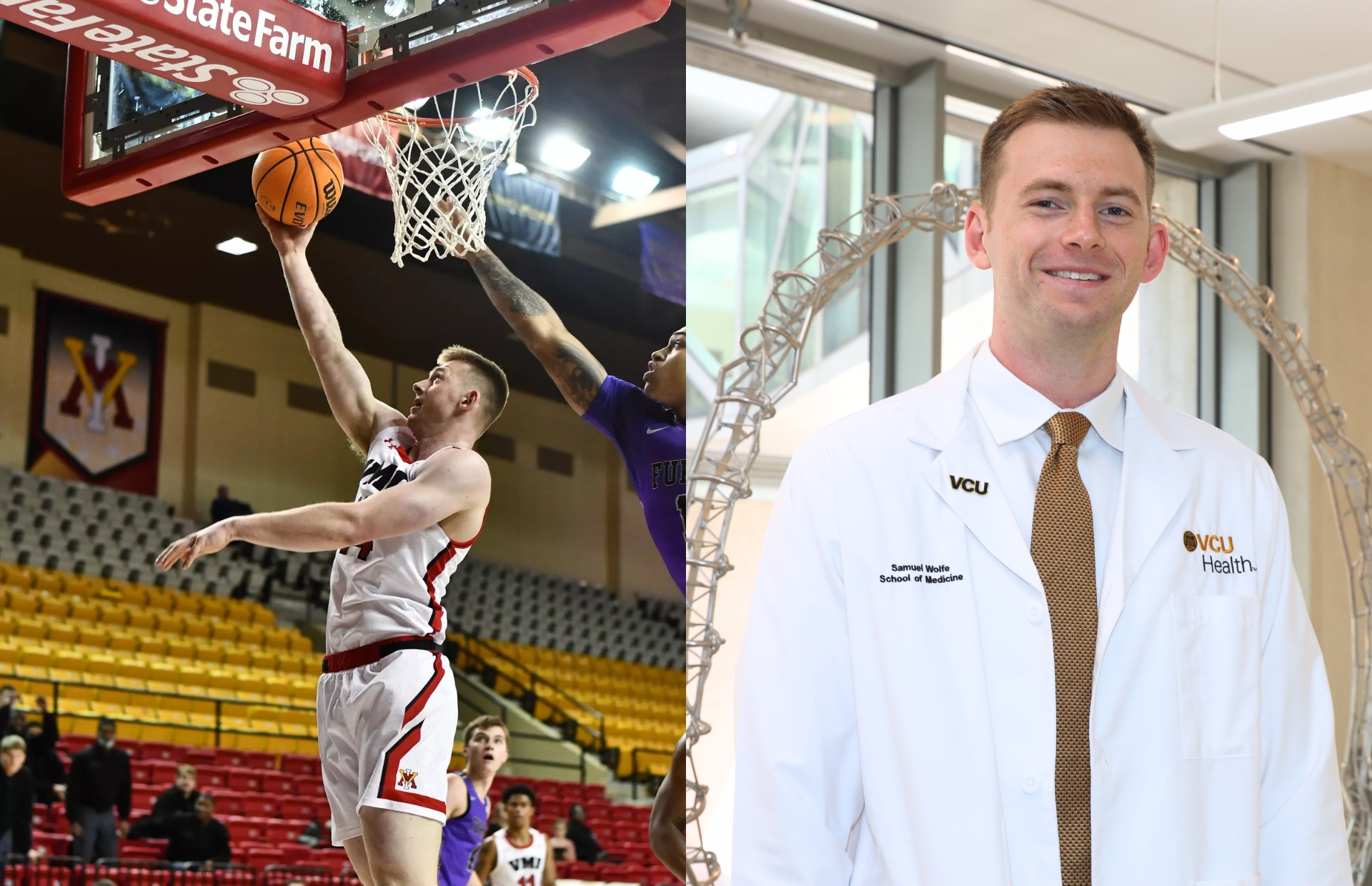
M3 Sam Wolfe playing for Virginia Military Institute Keydets basketball (Photo courtesy of VMI Athletics, Arda Athman)
Basketball has been a part of M3 Sam Wolfe’s life for as long as he can remember. He recalls dribbling a ball behind his grandmother’s trailer and tagging along with his dad, a former D1 player himself, for games at his alma mater. There, a 7-year-old Wolfe watched Davidson College sophomore point guard Stephen Curry at the beginning of his all-star career.
“That was a really cool experience, and I just looked up to my dad and all these 19- or 20-year-old kids that are just pouring their heart out on the court,” Wolfe said. “By the time I was in middle school, I knew I wanted to do that as well.”
A decade later, Wolfe was a forward on the Virginia Military Institute men’s basketball team. While he excelled with the team, Wolfe said he went through much of undergrad unsure of what was to come next. He credits his mentors and teammates for recognizing his hard work both on the court and in the classroom and encouraging him toward medicine. And after he shadowed a cardiothoracic surgeon for a week, he was sold.
“It was amazing to see how complex the human body is and how it works. It was also truly touching to see a group of people coming together to care for someone who is suffering," Wolfe said. “I’ve always liked being in a pack.”
Wolfe said he sees similarities between his time as a medical student and as a student-athlete. His time on the court taught him to be a part of something “bigger than himself.”
“In the basketball world, a player focused only on themselves isn’t going to make the team better. You have to have love in your heart for your teammates and their success as well,” Wolfe said. “I think it's the same in medicine. You have to learn to bring value to your team, no matter what.”
Send us your stories!
The School of Medicine communications team is always looking to highlight student success, faculty achievement, cutting-edge research and innovative initiatives around the MCV Campus. If you have an idea for a story, please submit your pitch to laura.ingles@vcuhealth.org.