Nurtured by nature: Investigating the potential of outdoor education as medicine
Inspired by a local park, third-year medical student Eleanor Dalsass wants to understand how nature can impact lifelong well-being.
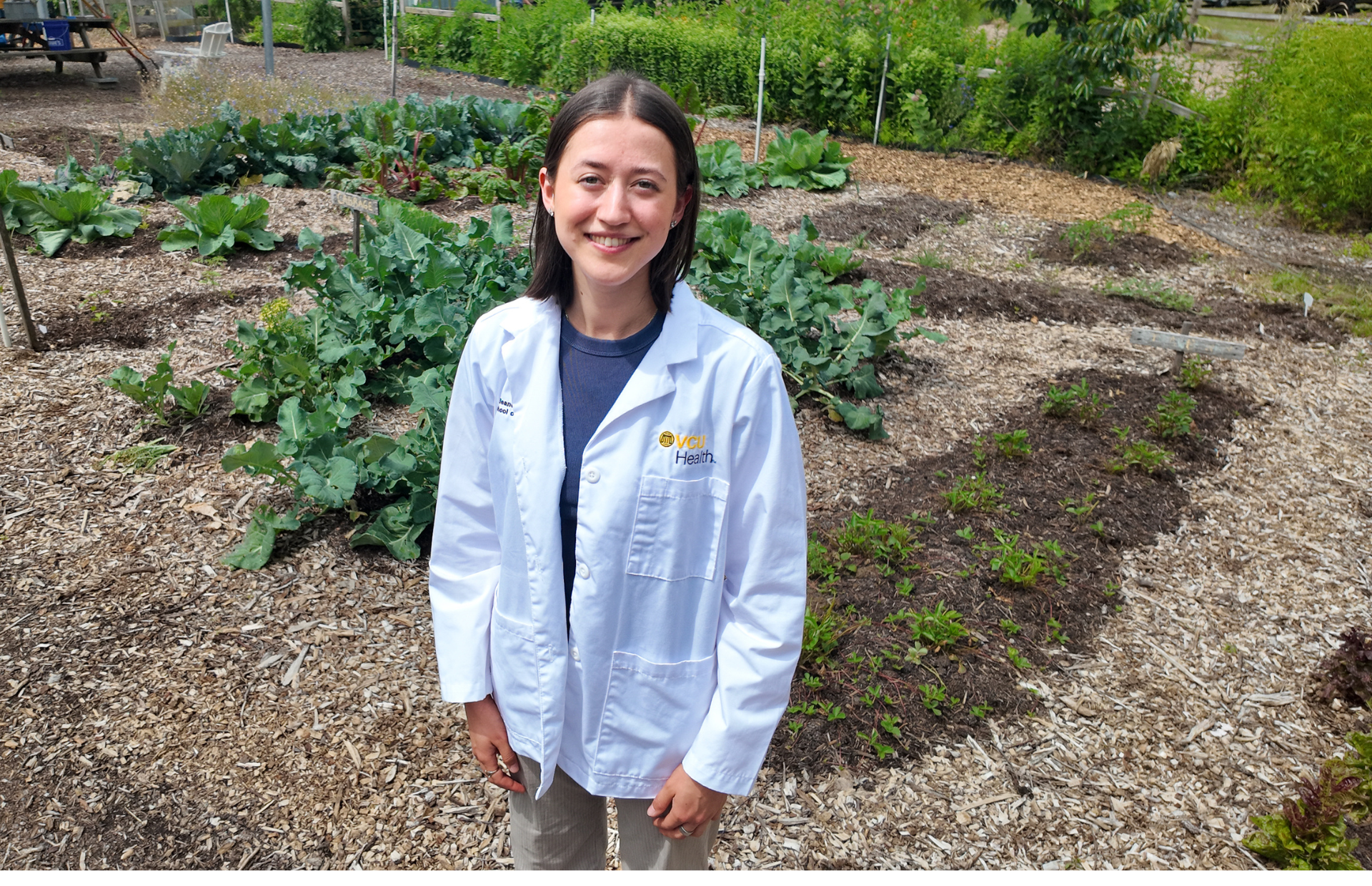
M3 Eleanor Dalsass in one of gardens at Bellemeade Park, where she frequently volunteers (Photo by Arda Athman, School of Medicine)
If you can’t find medical student Eleanor Dalsass on a clinical rotation, in a lecture or studying for an exam, there’s one other place you should look — Bellemeade Park.
Over the past two years, the M3 has traveled across the Manchester Bridge to Richmond's Southside where the working-class neighborhoods of Bellemeade, Oak Grove and Hillside Court come together. For Dalsass, tending to one of the park’s many gardens, planting native vegetation or clearing trails has been a welcome respite from the demands of medical school. Nature, she’s noticed, has a calming, positive effect on her and other visitors, including the neighborhood children who frequent the park on a daily basis.
“I knew there was something special at this park from my very first visit,” Dalsass said. “Seeing the work they do made me want to think about how I can use my skills to help in any way I can.”
Inspired by Bellemeade Park’s mission to make the outdoors accessible to all communities, Dalsass embarked on an investigation into the possible impact nature can have on the well-being of children in Southside and beyond.
“Being on the ground, in the community I'm hoping to impact, has been an amazing experience,” Dalsass said. “Being this connected and passionate about this research has made me more excited about my future and the possibility of my work to help my patients.”
Finding the spark
Dalsass was first introduced to Bellemeade Park through the Family Medicine Scholars Training and Admission program (fmSTAT), a dual-admission program for medical students committed to pursuing family medicine as a specialty. On a sunny Saturday morning in 2024, she and her fellow fmSTAT M1s traveled just 15 minutes from the MCV Campus to spend the day weeding, watering and planting at the park.
Marked only by a sign tucked between shotgun-style homes, the unassuming entrance to Bellemeade Park quickly gives way to a sprawling, eight-acre landscape. Featuring a forest walk, multiple learning gardens, an outdoor classroom, a football field, chicken coop and a bike repair shop, among other activities, the park is a slice of nature in an unexpected place. Each section of the park has a curriculum tied to it, with the goal of teaching the youth visitors how to feel comfortable and confident in the outdoors.
“For a lot of those kids, this is one of the only natural places around, and it's a place where they are able to feel safe and independent,” Dalsass said. “I wanted to explore that topic a little deeper and see how nature could enhance their lives.”
Dalsass took that spark of an idea to Jennifer Gilbert, Psy.D., a clinician researcher and associate professor in the Department of Family Medicine and Population Health, who said she could sense the student’s passion for her topic in their very first meeting.
“Being able to explain why you are interested in researching something that you have personal ties to takes vulnerability and bravery,” Gilbert said. “That human and personal connection that a researcher has to their project really draws people in. A student caring about what she studies helps engage other people in that work and enriches the quality of the research”
Together, Gilbert and Dalsass refined her project to focus on a common, yet critical public health issue that she believes programs like those at Bellemeade Park could impact — adverse childhood experience (ACEs).
ACEs encompass a range of potentially traumatic events that happen during childhood, typically split into three categories: abuse, neglect and household dysfunction. Childhood trauma increases a person’s susceptibility to internalizing disorders like depression and anxiety, and externalizing disorders like heightened aggression.
Over time, persistent exposure to adversity in childhood can also cause toxic stress, a condition in which the excessive activation of the body’s stress response alters neural and immune system development. Children exposed to ACEs, especially more than one, are more likely to develop chronic diseases later in life, including heart disease, diabetes and cancer, in addition to psychiatric conditions.
“A lot of the work we do in the Department of Family Medicine is looking at these big social and environmental factors that affect all individuals, regardless of their background,” Gilbert said. “We look at how these different experiences relate to health and health outcomes.”
Alongside programs aimed at preventing traumatic events from occurring in the first place, early therapeutic intervention is crucial in disrupting the negative health outcomes associated with exposure to ACEs. Traditional child-centric therapies, the most common form of intervention in the U.S., have proven successful in relieving stress and building resilience. Dalsass argues, based on her investigation, that nature education programs could produce similar positive outcomes.
“Children are so prone to emotional dysregulation, and we have evidence that being in nature can lead to higher self-esteem and a better ability to auto-regulate,” Dalsass said. “Nature-based education provides a structured and safe place for children to learn those skills.”
The curriculum at Bellemeade Park, she said, is designed by psychotherapists and emphasizes hands-on, immersive and active learning in a setting that is typically more engaging for children.
Activities include a vermiculture station, where children learn the vital role of earthworms in the ecosystem and practice being gentle when handling small creatures. Kelly Plonski, program coordinator with the Bellemeade Park Foundation, said one of the most popular spots is the community garden, where the kids can bring home the produce they harvest.
“The kids really love being outside and having the chance to play,” Plonski said. “Some of them have mentioned that they are learning more about themselves and want to take care of their environment.”
One of Dalsass’s favorite activities takes place in the wildflower garden, where students are encouraged to pick flowers to give to someone else.
“We asked each of them who they were going to give the flowers to and why,” Dalsass said. “Something small like that is a lesson about gift-giving, generosity and expressing gratitude. Its teaching them a non-selfish way of thinking.”
In a systematic review of literature published on the topic, Dalsass compared Bellemeade Park’s curriculum to other nature therapy and education programs. Most data, she noted, comes from research on programs in Europe and Asia, where nature therapy is a more common practice. Because of the similarities between the curricula, including an emphasis on autoregulation, self-esteem and stress reduction, Dalsass believes further analysis on the impacts of Bellemeade Park could uncover similar results.
“It's much more established in countries like Japan, the U.K. and Finland, where they actually have national, government-backed nature programs tied into primary care practices,” Dalsass said. “Bellemeade Park, I think, offers a model of what that could look like in the U.S. and shows that it is possible here as well.”
From investigation to impact
Establishing more nature therapy programs in the U.S., Dalsass said, would need to be intentional and considerate of existing inequities. Public parks and green spaces in American cities are concentrated in higher income communities, and parks that are in lower-income neighborhoods are, on average, smaller, have fewer amenities and are more likely to be poorly maintained.
Dalsass analyzed data from two national databases: the Trust for Public Land’s (TPL) ParkScore Index, a ranking of park systems in the 100 most populated cities in the U.S., and the Child Opportunity Index (COI), which measures and maps the quality of neighborhood resources and conditions that impact childhood development. She found an overlap between those living in TPL-designated “high priority” communities and low COI scores.
“Kids growing up in communities lacking resources are at a higher risk of exposure to ACEs, and these are the same kids who don’t have access to parks and natural spaces, much less nature education programs,” Dalsass said. “It's an accessibility issue that can only be addressed when we prioritize it.”
Expanding access, she believes, will reap benefits in populations beyond a community’s youth. Helping children of all social backgrounds to feel comfortable and capable in nature, Dalsass said, could also help close demographic gaps in park visitation rates.
“Having those positive memories in nature as a kid can help people feel more welcome in natural spaces as an adult,” Dalsass said. “These programs are teaching them lifelong skills and how to use nature as a tool for the rest of their lives.”
At Bellemeade Park, she’s seen one child's involvement in the programming create a ripple effect, with whole families getting involved in their kid’s participation.
“The volunteers that have been here for years said they have seen earlier bedtimes, better grades and just an overall improvement in the family dynamic,” Dalsass said. “A lot of the parents here really appreciate having a place where they know their kid will be safe and supervised by adults that care as much as they do.”
Plonski echoed Dalsass’s observation, noting that since starting as program coordinator in the spring of 2026, she’s met entire families that have become regular visitors. That sense of community, Plonski said, makes Bellemeade Park “more than just a large green space.”
“Bellemeade Park provides opportunities for children and families to explore and engage with the outdoors in meaningful ways,” Plonski said. “It’s a place for lifelong learning and connection, where people of all ages can experience the benefits of nature.”
Bridging interests
Throughout her research journey, Dalsass said she has felt supported by other family medicine clinicians. She presented her project at the 2025 Virginia Academy of Family Physicians Scholarly Symposium and was recently invited to join the arts and culture subgroup of the Virginia Ambulatory Care Outcomes Research Network (ACORN). Once a month, Dalsass and other family medicine students, faculty and professionals will discuss advancements in research and the relationship between arts, culture and primary care.
“My inspiration to pursue this was my passion for the park, and even if it reaches only a niche audience, that alone is encouraging,” Dalsass said. “I chose this topic because it is important and deserves to be studied.”
For Dalsass, researching a topic so close to home has strengthened her commitment to being an advocate for her community. The now M3 continues to make time between demanding clinical rotations to volunteer at Bellemeade Park, and said her investigation has given her a deeper understanding of the potential impact of her contributions.
“Conducting research within your own community is a very special thing, and it's something I intend to continue as a physician,” Dalsass said. “Being able to back up your ideas with evidence can really help when it comes to making a change.”
Send us your stories!
The School of Medicine communications team is always looking to highlight student success, faculty achievement, cutting-edge research and innovative initiatives around the MCV Campus. If you have an idea for a story, please submit your pitch to laura.ingles@vcuhealth.org.