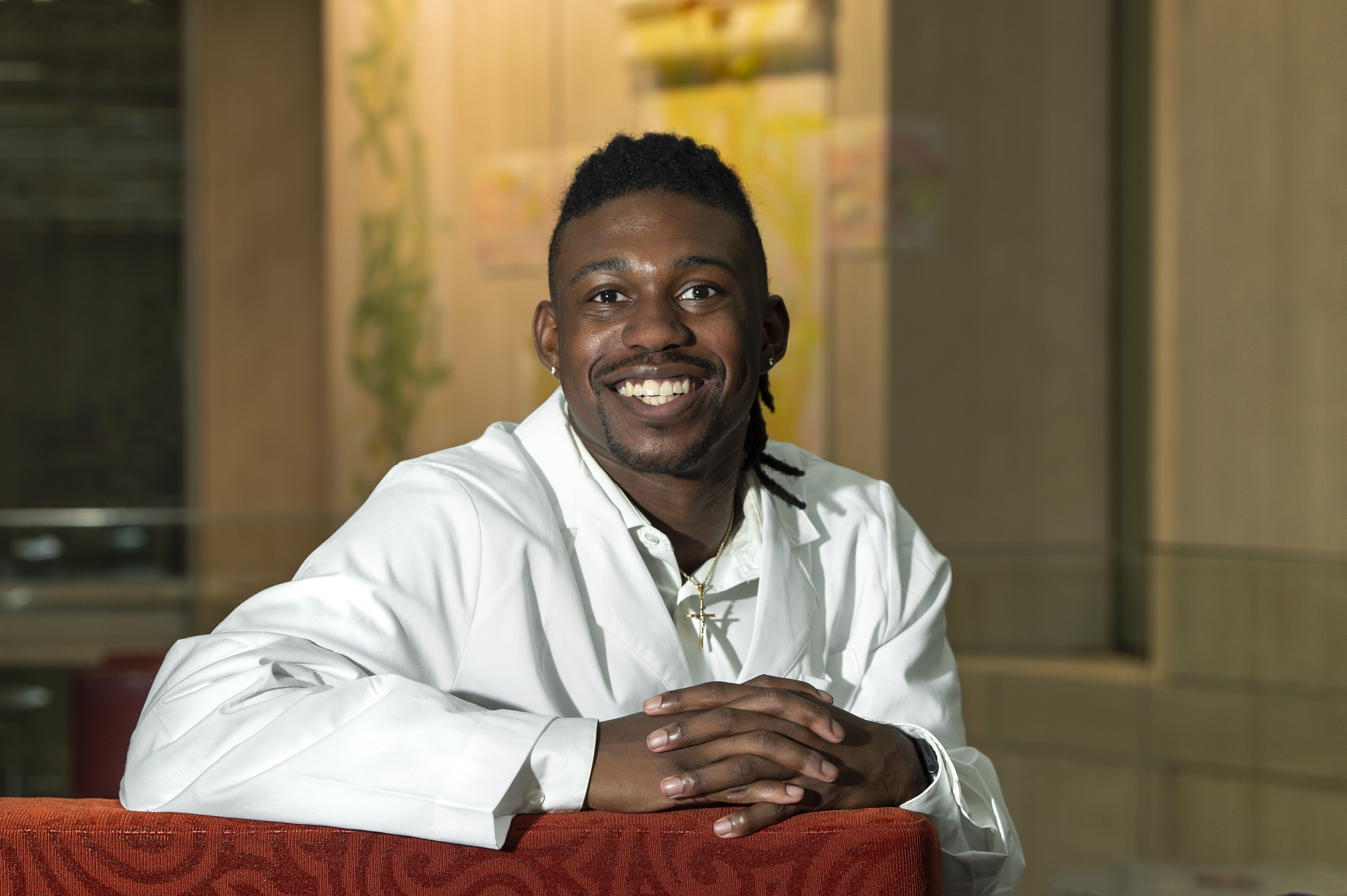
Flying high: M4 balances medical education and trapeze career
When Tucker Smith took a leave of absence from medical school to perform with Cirque du Soleil, he found lessons in teamwork and resilience that he believes will make him a better physician.
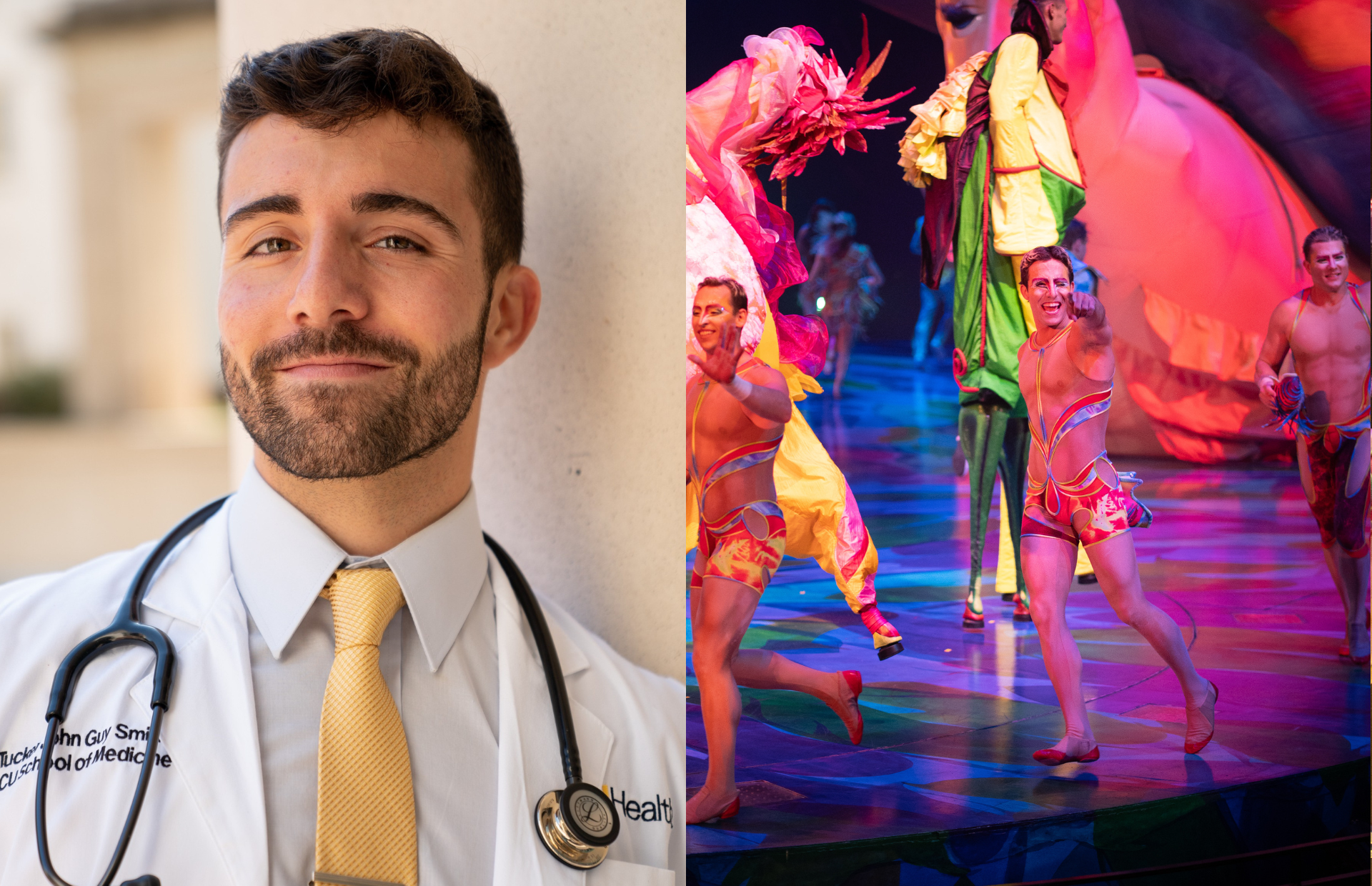
Over the past year, medical student Tucker Smith (center), has been performing trapeze in Las Vegas (courtesy photos)
Tucker Smith knows a thing or two about taking leaps of faith — literally.
Since taking a leave of absence from medical school in 2024, Smith has been soaring above crowds in Las Vegas with Mystére by Cirque du Soleil, one of the world’s most acclaimed aerial trapeze shows.
While his path to becoming a clinician may be unorthodox, Smith has found a way to embrace both of his passions. He plans to return to medical school next year to complete his M4 year, and approaches medicine with a new perspective shaped by his time training and performing with Mystére.
“There are so many similarities between the cooperative nature of trapeze and a profession like medicine,” Smith said. “Trapeze challenges me in the best way to be a better teammate in a high-pressure environment, and I think I will be a better physician because of it.”
Discovering passions
Smith first found trapeze by chance at a sleepaway summer camp he attended as a pre-teen. With a foundation in high-level junior gymnastics, Smith was drawn to the trapeze rig towering 30 feet in the air, overlooking the rest of the camp.
“I immediately fell in love with it and went back to camp every year to train after that,” Smith said. “It was so fascinating and so far removed from day-to-day life things that I found boring as a kid.”
Smith excelled at trapeze early on and was even scouted to join a professional troupe at just 14 years old. His mother advised him to postpone that opportunity until he was older, and it was around the same time that he began to explore another of his passions: medicine.
Having grown up with a health-savvy mom raised by Smith’s “country physician” grandfather, the thought of pursuing medicine as a career had always been in the back of Smith’s mind. But it wasn't until his freshman year in high school, when he connected with a physician treating him for a resistant staph infection, that he began exploring the possibility of going to medical school.
“He recognized that I had an interest in medicine and talked me through painful procedures,” Smith said. “From there on, I knew I wanted to do this too.”
Unexpected opportunities
After college Smith spent a year touring with the traveling aerial team the Flying Royals and moved to Richmond in 2021 after being accepted into the VCU School of Medicine. Between the rigors of medical school demanding his full attention and the lack of access to a nearby trapeze gym, he assumed that his performing days were behind him and committed to the process of becoming a doctor.
But when his father died at the start of his M4 year, Smith found himself drawn back to the activity that had always been an outlet.
“I feel like trapeze has always been there for me when I’ve needed it most,” Smith said. “It’s a centering force that challenges me but also gives me space to process and cope with the loss of my father.”
He had already filed for a leave of absence (LOA) from medical school to be with his family as his dad’s health started deteriorating, and in the final stages of his illness, Smith told his father about his dream of performing professionally again. His “usually pragmatic” father surprised him by supporting the decision, saying he “had earned the right to do this.” Empowered by the encouragement, Smith applied for an extension on his LOA and moved to Las Vegas to begin training again.
“It was something I needed to at least try,” he said. “I regret not taking the chance to do something that I cherish so much at the highest level.”
Even after three years away from the sport, Smith said that muscle memory took over as soon as he was back on the aerial rig, and it wasn’t long before he was executing the same complex skills he had performed in front of audiences years before. Not long after, a scout from Cirque du Soleil — his dream company — offered him a spot in the show.
Chris Woleben, M.D., associate dean of student affairs, has been working closely with Smith to ensure he has a successful transition back to medical school. LOAs are available to students throughout all four years of the M.D. program, for reasons ranging from illness or a death in the family to pursuing research, a master's degree or, in Smith’s case, joining Cirque du Soleil. Chasing a professional trapeze dream is one of the more unique LOA requests Woleben has encountered, and he noted that the process can be tailored to each student’s specific needs, academic standing and goals.
“We want to be supportive of anything that students want to do, as long as it makes sense and they have a good plan for their future career,” Woleben said. “Tucker has done remarkably well keeping us updated to ensure his transition back to medical school goes smoothly.”
Living the dream
 Now, Smith’s life is dramatically different, but just as busy and fulfilling as when he was a full-time medical student. Twice a day, five days a week, Smith soars above a crowd of thousands, performing death-defying flips with the complete trust that his teammates will catch him. He comes home sore and exhausted but spends his free time brushing up on his medical studies. He knew that he’d have to stay on top of his education during his time in Vegas, but leaping from platforms is what has given him new perspective on his future as a doctor.
“At some point in trapeze, you’re going to fall. It’s inevitable and happens in front of thousands of people. But you have to be able to get back up and make meaning out of those failures,” Smith said. “It's the same in medicine. At some point you’re going to not do as well as you hoped, but you can’t let that define you.”
When he begins the match process next year, Smith intends to pursue physical medicine and rehabilitation. He is eager to work with patients, especially fellow athletes, to help them get back on their feet after a musculoskeletal or nervous system diagnosis or injury.
“When an athlete is told they can’t do something they love because of injury, it’s devastating,” he said, noting that he has seen injuries and recoveries among his Mystére colleagues. “But the ability of athletes to heal physically and mentally after injury can be really triumphant.”
Smith knows his return to medicine will be an adjustment, especially without his usual outlet of trapeze, but said he looks forward to resuming his medical education and graduating with the Class of 2027. He is grateful for the understanding and encouragement he has received from the School of Medicine and the opportunity he has had to pursue both of his dreams.
“The road to becoming a physician takes years and years, and medicine is something most people do for the rest of their life,” Smith said. “I think as long as you work hard and have a plan, making your own path is okay.”